Forward Induction
Definition
Forward induction is a principle for selecting among equilibria of an extensive-form game. A player who observes an earlier move interprets it as a deliberate choice by a rational opponent: if the move could only have been worthwhile for the mover under some continuations, the observer expects those continuations. In particular, play after a move is not expected to give the mover less than she could have secured by choosing differently earlier.
The course mentions forward induction only briefly, as a minor remark.
Forward induction is an idea rather than a single equilibrium concept. It is used to discard some subgame-perfect Nash equilibria; formal versions include iterated elimination of weakly dominated strategies in the normal form and stable equilibria (Kohlberg–Mertens).
Interpretation
Backward induction evaluates the present by looking at the future: what will be optimal later determines what is optimal now. Forward induction looks at the past to predict the future: what a player already did reveals what she intends to do. The two can point in different directions when a subgame has several equilibria.
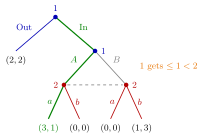
The figure draws the outside-option game of the Examples. After In, player 2 cannot see whether player 1 chose or (dashed information set), and this subgame on its own has several equilibria. Forward induction reads the move In itself: player 1 gave up the sure of Out, and can give her at most , so she must intend . Player 2 then plays , and only the highlighted path to survives.
Subgame perfection treats every subgame as if it started afresh, ignoring how play arrived there. Forward induction adds the information carried by the path. It does not reject subgame perfection; it selects among subgame-perfect equilibria.
Claims should be kept modest: different formalizations can select differently in more complicated games, and forward-induction arguments assume that rationality of the earlier mover is believed even after a move that some equilibria treat as a mistake.
Key Results
- A move that gives up a sure payoff is consistent with rational choice only if the mover expects at least from continuing. Rationality alone rules out continuations whose best possible payoff is strictly below ; a tie is not enough. Inferring a strict improvement requires an additional assumption about choosing between tied alternatives.
- In the normal form this often appears as a strictly dominated strategy for the mover (an action plan worse than the outside option), followed by weak dominance for the observer.
- Forward-induction arguments select among existing equilibria (in the examples here, among the SPNE); they do not create new equilibria.
- In the burning-money game (Battle of the Sexes preceded by player 1's option to publicly destroy one unit of her own payoff), iterated elimination of weakly dominated strategies leaves only the outcome in which player 1 does not burn and the players coordinate on her preferred equilibrium.
Beyond the course
In signalling games, the intuitive criterion (Cho and Kreps) applies the same reasoning to off-path beliefs in a perfect Bayesian equilibrium: after a message that no type sends, beliefs should put no weight on a type that could not gain from it, compared with its equilibrium payoff, whatever the receiver's response. The course does not cover it.
Examples
Outside option. Player 1 chooses Out, giving , or In, after which both play simultaneously: , , and after miscoordination. This game has three SPNE, with outcomes via (In , ), and via (Out , ) and via Out with the mixed subgame equilibrium.
Forward induction: if player 2 sees In, she reasons that player 1 gave up . Playing after In gives player 1 at most , while can give . So player 1 must intend , and player 2's best response is . Only (In , ) survives.
The same argument through dominance. In the reduced normal form, where the payoff-equivalent plans (Out, ) and (Out, ) are merged into Out, the strategy (In, ) gives player 1 either or and is strictly dominated by Out, which gives . Remove it. Against the remaining strategies (Out, In ), player 2 gets from both and against Out, while against In she gets from and from , so is weakly dominated. Remove . Now player 1 compares In () with Out () and chooses In .
Prerequisites
Related Concepts
- Backward Induction
- Sequential Rationality
- Iterated Elimination of Strictly Dominated Strategies
- Perfect Bayesian Equilibrium
Sources
- Game Theory · Week 3
Aliases: forward-induction reasoning, forward induction argument Keywords: outside option, burning money, equilibrium selection, refinement of SPNE, iterated weak dominance
Last updated: 27 October 2026 11:52
Forward InductionExtensive-Form GameSubgame-Perfect Nash EquilibriumStrictly Dominated StrategyBackward InductionSequential RationalityIterated Elimination of Strictly Dominated StrategiesPerfect Bayesian Equilibrium