Bertrand Duopoly
Definition
In a Bertrand duopoly two firms sell an identical (homogeneous) product and simultaneously choose prices . Both have the same constant marginal cost , and market demand is continuous and nonincreasing with (for example with and ). Consumers buy from the cheaper firm, and split equally at equal prices:
and symmetrically for firm 2. Prices are continuous, so .
Interpretation
With identical products, a slightly lower price captures the whole market. When both firms charge the same price above cost, undercutting by a small amount roughly doubles a firm's sales at almost the same margin. This undercutting pressure drives prices down to marginal cost.
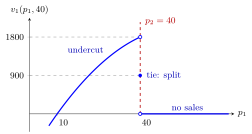
The figure uses the example below, and , and fixes the rival's price at . Matching the rival gives firm 1 half the market, a profit of ; any price just below gives the whole market and a profit close to ; any price above sells nothing. The open circle at is never reached, which is why no best "just below" price exists, and repeating this argument at every common price above pushes the equilibrium down to .
With , move towards from below: the profit approaches but drops to at the tie. Lower towards and the gain from undercutting shrinks to nothing.
The result, two firms already pricing as under perfect competition, is called the Bertrand paradox. It contrasts with the Cournot duopoly, where quantity competition gives a price above cost: the choice of strategic variable (price or quantity) changes the prediction. The paradox disappears with differentiated products, capacity limits or repeated interaction (see repeated game, Week 4).
A common error is to look for an equilibrium with a small positive margin, "just below" the rival. With continuous prices there is no best "just below" price, so best responses can fail to exist (see the best-response correspondence).
Key Results
- The unique Nash equilibrium is ; both firms earn zero profit.
- Proof by cases (the argument for is symmetric):
- : either firm gains by undercutting. If , a price slightly below raises its profit from to almost ; if , a price slightly above gives a positive profit.
- : firm 2 earns and can earn a positive profit by pricing slightly above (and below ).
- : firm 1 earns and can earn a positive profit by pricing slightly above but below .
- with : firm 1 makes a loss and gains by raising its price above .
- : lowering the price gives a loss and raising it gives zero sales; no deviation helps.
- In equilibrium each firm's strategy is a best response but is not strictly better than every alternative: any also gives zero against .
- With a discrete price grid of step (for example cents) that contains , and , both and are Nash equilibria; the latter because deviating to gives , and every other deviation gives zero or a loss.
Examples
Let and .
Undercutting. At , each firm earns . Firm 1 deviating to earns , so is not an equilibrium.
At cost. At , each earns . Raising to sells nothing and still earns ; lowering to earns . Neither firm can gain, so is the equilibrium.
Comparison. The Cournot equilibrium with the same demand and cost has price and profit per firm; Bertrand gives price and profit .
Prerequisites
Related Concepts
Sources
- Game Theory · Week 1
Aliases: Bertrand competition, Bertrand model, price competition, Bertrand game, price-setting duopoly Keywords: Bertrand paradox, undercutting, p1 = p2 = c, homogeneous product, marginal-cost pricing, discrete price grid Symbols: infinity
Last updated: 27 October 2026 11:52
Bertrand DuopolyNash EquilibriumBest ResponseCournot DuopolyBest-Response CorrespondencePareto EfficiencyRepeated Game