Cournot Duopoly
Definition
In a Cournot duopoly two firms produce a homogeneous good and simultaneously choose quantities . In the standard linear version:
- the market price is given by the inverse demand with , ;
- each firm has constant marginal cost with , so its cost is ;
- firm 's payoff is its profit .
This is a static game of complete information with strategy sets .
Interpretation
Each firm's profit depends on the rival's quantity through the common price: more output by the rival lowers the price and makes one's own output less valuable. With positive marginal cost, a firm's best response is nonincreasing as the rival's quantity rises. Zero marginal cost has an additional boundary case described below.
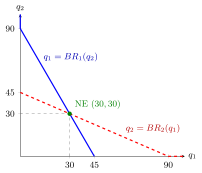
The figure uses the numbers below (, , ). Firm 1's reaction line gives its profit-maximizing output for each , and firm 2's line does the same with the roles swapped. The positive-output portions slope downwards; when the rival produces at least , the best output is zero. The only point on both lines is , where each quantity is a best response to the other, so it is the Nash equilibrium.
For , drag the profile : the orange arrows show the unique best responses, which meet at for the initial parameters. Changing , and moves this equilibrium to . At , additional zero-price equilibria need the best-response correspondence described below.
The equilibrium is found by computing both best responses and solving them together, which is the definition of a Nash equilibrium applied to continuous strategies. Taking the partial derivative of with respect to the firm's own quantity, holding the rival's fixed, is the key step; differentiating the sum or the rival's quantity is a common error.
The positive-price equilibrium lies between monopoly and perfect competition: the firms together produce more than a monopolist, but less than the competitive output at which price equals marginal cost.
Key Results
- For , the unique best response is the following. In the positive-price region, the first-order condition is , with ; the nonnegative constraint gives the zero branch:
- For , the unique Nash equilibrium is , total output , price , profit per firm.
- At , the same positive-price equilibrium exists, but uniqueness fails under the stated truncated demand. If , the unique best response is ; if , every gives price zero and profit zero, so every quantity is a best response. Thus, in addition to the positive-price equilibrium, every profile with is a zero-price equilibrium.
- A monopolist would produce ; perfect competition gives ; so .
- If each firm produced (half the monopoly output), each would earn , but this is not an equilibrium: each firm's best response to is . The equilibrium is not Pareto efficient for the firms.
- With identical firms, a symmetric positive-price equilibrium is .
Examples
Numbers. Let , , , so when and otherwise.
- In the region , profit is ; the first-order condition gives for .
- By symmetry . Solving this system of linear equations: , so and .
- Hence , , profit each.
- Check: against , producing gives and producing gives , both below .
Prerequisites
Related Concepts
Sources
- Game Theory · Week 1
Aliases: Cournot competition, Cournot model, quantity competition, Cournot game, quantity-setting duopoly Keywords: inverse demand p = a - b(q1 + q2), q_i = (a - c)/(3b), reaction function, Cournot-Nash equilibrium, collusion, Cournot oligopoly Symbols: infinity, partial
Last updated: 27 October 2026 11:52
Cournot DuopolyStackelberg CompetitionNash EquilibriumBest ResponseFirst-Order ConditionPartial DerivativeBertrand DuopolyBest-Response CorrespondencePareto Efficiency