Folk Theorem
Theorem
Let be a finite stage game and consider its infinite repetition with discount factor and average discounted payoffs . The set of feasible payoffs is the convex hull, the smallest convex set containing every stage payoff vector,
Folk theorem. Let be the payoff vector of a Nash equilibrium of the stage game. For every feasible that is strictly larger, for all , there is such that for all the repeated game has a subgame-perfect Nash equilibrium with average payoff . Past actions are assumed to be observed.
Interpretation
The name records that the result was known informally before anyone published it. Its message: with patient players and observed actions, repetition does not narrow the predictions; almost anything reasonable can be an equilibrium. "Reasonable" has two parts. Feasibility: the payoff must be an average of stage payoffs. Improvement: each player must get strictly more than in the stage Nash equilibrium that serves as the punishment.
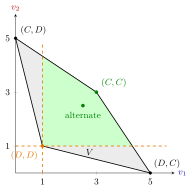
The figure draws the Prisoner's Dilemma of the Examples. The whole quadrilateral is the feasible set , and the dashed lines are the thresholds , the stage Nash payoffs of . The green part, where both players get more than , is the set of payoffs the theorem sustains for close to . It contains cooperation and the limit of the alternation payoffs, while the corners and are feasible but give one player less than .
Drag the target payoff : the theorem covers the green part of the feasible set, where both players get more than the stage Nash payoff . Lower below and grim trigger can no longer sustain .
The course version is proved with the grim trigger strategy: play a path that yields and revert to the stage Nash equilibrium forever after a deviation.
The theorem says equilibria exist, not which will be played. It covers efficient outcomes (cooperation, collusion) and inefficient ones alike. It also needs close to 1; for a fixed the set of equilibrium payoffs may be much smaller.
Key Results
- The repetition of a stage Nash equilibrium is always an equilibrium, so the equilibrium set is nonempty for every .
- No folk theorem for subgame-perfect equilibria holds under finite repetition of a stage game with a unique Nash equilibrium: the only SPNE repeats that equilibrium in every period.
Beyond the course
Textbooks also state a minmax folk theorem (Fudenberg and Maskin, 1986), in which the stage Nash payoff is replaced by the minmax payoff, the lowest payoff the other players can hold a player to; payoffs above it are called individually rational. The course does not cover this version.
Examples
Prisoner's Dilemma. With , , , , is the quadrilateral with these corners and the stage Nash payoff is . The payoff needs . Alternating and under grim trigger gives averages and , which tend to . A player who gets 0 this period earns from now on, against 1 from deviating, so this path is sustained if and only if .
Prerequisites
Related Concepts
Sources
- Game Theory · Week 4
Aliases: folk theorem for repeated games, Friedman's folk theorem, Nash-threats folk theorem Keywords: feasible payoffs, individually rational payoffs, Nash reversion, minmax payoff, Fudenberg–Maskin, patient players, delta close to 1, convex hull of stage payoffs, Prisoner's Dilemma Symbols: delta, element of, infinity, real numbers, subset, sum
Last updated: 17 October 2026 21:53
Folk TheoremRepeated GameGrim Trigger StrategySubgame-Perfect Nash EquilibriumMixed StrategyOne-Stage Deviation PrincipleTrigger StrategyPareto EfficiencyChicken GamePrisoner's Dilemma