Type
Definition
In a Bayesian game, a game of incomplete information, player 's type is everything payoff-relevant that knows privately and the others do not, such as her cost, valuation, quality or preferences. It is drawn from a type space and observed only by . A profile of types is , an element of the Cartesian product , and payoffs may depend on the whole profile. From the others' point of view, is a random variable whose distribution is part of the description of the game.
Interpretation
In a normal-form game every player's payoff function is common knowledge. Types relax exactly this: the structure of the game (players, actions, the type spaces and the distribution of types) remains common knowledge, but the realized type of each player is private. Uncertainty about another player's payoffs becomes uncertainty about which type she is.
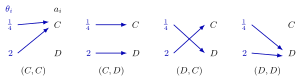
In the figure (the private-costs example below), each panel is one pure strategy of neighbour : arrows assign an action, or , to each cost type . Two types with two possible actions each give such maps, the four pure strategies , , and , although only one type is realized and only one action is taken.
A type also fixes the player's beliefs. Given a common prior over , type believes the others' types are distributed as ; with independent types this belief does not depend on .
The key consequence for strategies: because the other players do not see , they must predict what every type of would do. A strategy is therefore a type-contingent plan , not a single action, even though only one type is realized. Treating each type as a separate "player" who maximizes her own expected payoff is a useful way to think about this.
Key Results
- With finite and , player has pure strategies.
- A player with a single possible type () has no private information; if all players do, the game reduces to a game of complete information.
- Types are the moves of Nature in the Harsanyi transformation: Nature draws , and each player observes only her own component.
- A type can encode information about the state of the world (for example, a signal about a common value), not only preferences.
Examples
Private costs. Two neighbours decide whether to contribute to a shared good worth 1 to each if at least one contributes. Contributing costs , known only to . With actions (contribute) and (decline), a strategy for lists an action for each cost: , , or , where the first entry is the action of the low-cost type. That is pure strategies, although each neighbour takes only one action.
Quality. A used-car seller's type is the car's quality . The buyer does not observe it and must form beliefs about it; this is the setting of the market for lemons.
Prerequisites
Related Concepts
Sources
- Game Theory · Week 5
Aliases: player type, type of a player, private type Keywords: theta_i, type space, private information, incomplete information, type-contingent strategy Symbols: element of, theta
Last updated: 17 October 2026 21:53
TypeAdverse SelectionBayesian GameCommon PriorHarsanyi Purification TheoremMarket for LemonsPrivate-Value AuctionSignalling GameNormal-Form GameCommon KnowledgeRandom VariableHarsanyi TransformationBayesian Nash Equilibrium