Grim Trigger Strategy
Definition
In an infinitely repeated game with discount factor , fix a target action profile and a stage-game Nash equilibrium . The grim trigger strategy of player is
- play at and in every period whose history consists only of ;
- play after every other history, that is, forever once anyone has deviated from .
It is the trigger strategy whose punishment phase never ends.
Interpretation
Among trigger strategies that punish with a given stage equilibrium that gives every player less than , grim trigger punishes longest, so it needs the least patience. Its incentive check is short. After any deviation, play is forever, which is a Nash equilibrium of every such subgame. On the cooperative path, a player compares the stream forever with the best one-period gain followed by forever.
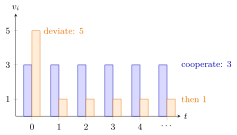
The figure draws this comparison for the Prisoner's Dilemma of the Examples. Cooperating gives in every period (blue); deviating gives , the payoff of defecting against a cooperator, once and then, because the opponent's grim trigger plays forever, the mutual-defection payoff in every later period (orange). The deviation gains now and loses in every later period, so it pays only when the future is discounted heavily: cooperation is optimal if and only if .
The filled parts of the bars are discounted payoffs. With the default payoffs , , and , deviation pays at and cooperation is optimal from . Changing the payoffs changes this threshold; the punishment must also remain credible.
The profile in which everyone uses grim trigger is a subgame-perfect Nash equilibrium if and only if, for every player ,
that is, when .
Grim trigger is unforgiving: a single mistake destroys cooperation forever, even though both players would prefer to restart. This makes it fragile as a description of behaviour, but it is the standard device for showing which outcomes can be sustained at all.
Key Results
- In a Prisoner's Dilemma, grim trigger sustains in every period as a subgame-perfect equilibrium if and only if is at least the one-period gain from defecting against a cooperator divided by the difference between that defection payoff and the mutual-defection payoff; in the Examples, .
- The threshold lies in . It rises when the payoff from defecting against a cooperator or the mutual-defection payoff rises, and falls when the mutual-cooperation payoff rises.
- Off the path, punishment is credible because is a stage-game Nash equilibrium.
- Here is the best payoff from an action other than . If is itself a stage equilibrium, then , so deviating gains nothing today. The condition then holds for every if for all (in particular if ). If some player strictly prefers the punishment equilibrium, , it holds only for : a strict stage equilibrium is sustained for small , and the condition fails for every when some deviation ties, .
Examples
Prisoner's Dilemma. Take , , , . Cooperating forever gives in total; defecting now gives . Cooperation is optimal if and only if
At a defector gets average , so cooperation fails.
Collusion in a Cournot duopoly. In a Cournot duopoly with inverse demand and unit cost , write . Producing half the monopoly output, each, gives profit ; the best deviation against it is with profit ; Cournot play gives . Grim trigger sustains collusion if and only if
Prerequisites
Related Concepts
- Folk Theorem
- One-Stage Deviation Principle
- Cournot Duopoly
- Pareto Efficiency
- Prisoner's Dilemma
- Equilibrium Path
Sources
- Game Theory · Week 4
Aliases: grim trigger, grim strategy, grim-trigger strategy Keywords: permanent punishment, delta >= (5-3)/(5-1), critical discount factor, cooperation in the repeated Prisoner's Dilemma, collusion 9/17 Symbols: delta, element of
Last updated: 27 October 2026 11:52
Grim Trigger StrategyFolk TheoremTrigger StrategyRepeated GameSubgame-Perfect Nash EquilibriumOne-Stage Deviation PrincipleCournot DuopolyPareto EfficiencyPrisoner's DilemmaEquilibrium Path