Pareto Efficiency
Definition
Let be the set of pure-strategy profiles of a normal-form game with players and payoff functions .
A profile Pareto dominates if
A profile is Pareto efficient (Pareto optimal) if no profile in Pareto dominates it. Moving from to a profile that Pareto dominates it is a Pareto improvement.
Interpretation
Pareto efficiency judges outcomes from the point of view of the players as a group: an outcome is inefficient if someone could be made better off without anyone being made worse off. It is a statement about payoffs, not about how the outcome could be reached.
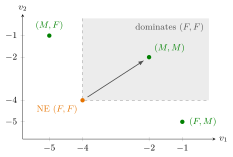
The figure plots each profile of the Prisoner's Dilemma example as the point . A profile Pareto dominates exactly when its point lies in the grey quadrant to the north-east, weakly better for both and not equal; lies there, so the equilibrium is inefficient and the arrow is a Pareto improvement. The three green points have no other point north-east of them, so they are Pareto efficient, and and cannot be ranked against or each other.
This separates two questions. A Nash equilibrium asks whether any single player gains by deviating; Pareto efficiency asks whether the group could do better. Non-cooperative analysis predicts play from individual incentives, so equilibria can be inefficient.
Two misunderstandings are common. Pareto efficiency is not fairness: giving one player everything can be efficient. And an efficient profile need not be better for everybody than an inefficient one; it only needs to be undominated.
Only the players' payoffs count. In a duopoly the players are the firms, so a profile that raises both firms' profits at the expense of consumers is still a Pareto improvement for the game.
Key Results
- Pareto dominance is transitive and never holds between a profile and itself, but it is not complete: two profiles can be incomparable.
- In a finite game a Pareto-efficient profile always exists: any profile that maximizes is Pareto efficient, because a Pareto improvement would raise the sum.
- A Nash equilibrium need not be Pareto efficient, and a Pareto-efficient profile need not be a Nash equilibrium.
- A strictly dominant strategy equilibrium can be Pareto dominated (Prisoner's Dilemma).
Examples
1. Prisoner's Dilemma with payoffs , , , .
- Pareto dominates , since for both players. So the equilibrium is not Pareto efficient.
- is Pareto efficient: every other profile gives player 2 less than .
- Likewise and are Pareto efficient, so three of the four profiles are efficient.
2. Battle of the Sexes with , and mismatches . Both and are Pareto efficient and incomparable: each is better for one player. Both mismatches are Pareto dominated.
3. Cournot duopoly. In a Cournot duopoly with price and unit cost , the equilibrium gives price and profit each. If each firm produced , the price would be and each profit , a Pareto improvement for the firms that is not an equilibrium.
Prerequisites
Related Concepts
Sources
- Game Theory · Week 1
Aliases: Pareto optimality, Pareto efficient, Pareto optimal, Pareto optimum Keywords: Pareto dominates, Pareto dominated, Pareto improvement, collective welfare, cooperation versus equilibrium, Prisoner's Dilemma, Battle of the Sexes Symbols: element of, sum
Last updated: 22 October 2026 19:04
Pareto EfficiencyPrisoner's DilemmaNormal-Form GamePure StrategyNash EquilibriumStrictly Dominant StrategyCournot DuopolyFolk Theorem