Best-Response Correspondence
Definition
The best-response correspondence of player assigns to every profile of the other players' strategies the set of player 's best responses:
A correspondence is a rule that assigns to each point a set, which may contain several elements or be the empty set. If contains exactly one element for every , the correspondence is an ordinary function, called a best-response function (or reaction function).
Interpretation
The correspondence summarizes all of player 's optimal reactions in one object. Several strategies can be optimal against the same when payoffs tie, which is why a set is used rather than a single value.
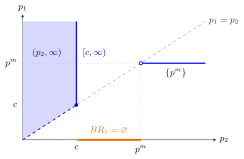
The figure draws Example 3 below: above each rival price it shows the whole set . For the set is the open region above the diagonal, at it is the vertical ray , and for it is the single point , where the correspondence behaves like a function. For nothing is drawn above the axis, because the set of best responses is empty.
Move the rival price and read off above it: a region for , a ray at , nothing between and , and the single point beyond.
A frequent mistake is to report only one maximizer when several tie; a Nash equilibrium can then be missed. A second is to assume is always nonempty: in games with infinite strategy sets the supremum of the payoff may not be attained.
Key Results
- A profile is a Nash equilibrium if and only if for every .
- For two players with interval strategy sets, the Nash equilibria are the intersection points of the graphs of and drawn in the same plane.
- If is finite, is nonempty for every .
Examples
1. Ties. Suppose player 1 has strategies , , and, against player 2's strategy , receives , , . Then , a two-element set.
2. Cournot reaction functions. In a Cournot duopoly with price and unit cost ,
Both are single-valued. Their intersection solves and , so .
3. Bertrand: an empty set. In a Bertrand duopoly with identical products, unit cost , demand with and , and monopoly price :
- if (any price that sells nothing);
- if (profit is at best);
- if : firm 1 wants to price just below , but no largest price below exists;
- if .
Prerequisites
Related Concepts
Sources
- Game Theory · Week 1
Aliases: Best Response Correspondence, best-reply correspondence, BR correspondence, reaction curve, best-response curve Keywords: BR_i(s_{-i}), set-valued map, best-response function, reaction function, intersection of best-response curves Symbols: element of, infinity
Last updated: 27 October 2026 11:52
Best-Response CorrespondenceNash Equilibrium in Mixed StrategiesNash EquilibriumNash Existence TheoremBest ResponseFunctionCournot DuopolyBertrand Duopoly