Pooling Equilibrium
Definition
In a signalling game, a pooling equilibrium is a perfect Bayesian equilibrium in which every type of the sender chooses the same message . On the path the receiver's belief after equals the common prior,
and the receiver best responds to the prior. Every other message is off the equilibrium path, and the beliefs there are part of the equilibrium but not restricted by Bayes' rule.
Interpretation
In a pooling equilibrium the message carries no information: the receiver learns nothing it did not already know. This can happen even when types differ a lot, as long as no type gains from breaking away.
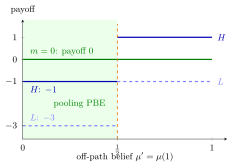
The figure checks the "pooling on the free message" example for every possible off-path belief . Staying at is rejected and pays both types (green). Deviating to pays if the receiver rejects, which she does when , and if she accepts, which she does when , minus the cost: or for , and or for . The payoff never reaches , and the payoff stays below it exactly when the receiver rejects , so the shaded beliefs support the pooling equilibrium, while beliefs above make break away.
Move the off-path belief : pooling on survives while , so that the receiver rejects . Raise above and every belief supports pooling.
Whether a type gains from deviating depends on how the receiver would interpret the deviation, that is, on the off-path part of the system of beliefs. Pooling equilibria are typically supported by pessimistic off-path beliefs: any deviation is read as coming from the "bad" type, which makes deviation unattractive. Since PBE allows any off-path belief, many pooling equilibria can exist; forward induction, mentioned only briefly in the course, asks whether such beliefs are plausible.
A frequent mistake is to check only the on-path condition. A complete verification has three parts: on-path beliefs equal the prior; the receiver's actions are optimal after the pooled message and after each unused message given the stated beliefs; and no type prefers an unused message.
Key Results
- On the path the posterior equals the prior, because all types send with probability one.
- Fix a receiver action after that is a best response to the prior. Pooling on with that action is a PBE if and only if some off-path beliefs, with optimal receiver responses to them, make every type weakly prefer to every other message.
- When the receiver's response is monotone in the belief, as in the example below, more pessimistic off-path beliefs make pooling easier to sustain; with sufficiently optimistic ones it can break down.
- Pooling and separating equilibria can coexist and give different payoffs: in the example below type gets when pooling and in the separating equilibrium.
Examples
Pooling on the free message. In the signalling game example, type (prior ) and type send for free or at cost or . The receiver accepts () or rejects (); accepting gives her against and against , rejecting gives , so with belief she accepts if and rejects if . The sender gets if accepted and if rejected, minus her cost.
- On path: , so the receiver rejects after and both types get .
- Off path: let . If the receiver rejects after , and deviating gives only and only . If she accepts, and would get , so deviates.
So pooling on , with rejection after both messages, is a PBE for every off-path belief (at the receiver is indifferent and rejecting is a best response), but not for .
Pooling on the costly message. If both types chose , then , the receiver rejects, and would get , while gives at least whatever is. Hence pooling on is not a PBE.
Prerequisites
Related Concepts
Sources
- Game Theory · Week 7
Aliases: pooling PBE Keywords: all types send the same message, posterior equals prior, off-path beliefs, pessimistic beliefs, uninformative signal Symbols: element of, mu, theta
Last updated: 14 October 2026 08:21
Pooling EquilibriumSignalling GamePerfect Bayesian EquilibriumSystem of BeliefsCommon PriorSeparating EquilibriumBayes Rule for BeliefsForward InductionAdverse Selection