Prisoner's Dilemma
Definition
The Prisoner's Dilemma is a symmetric two-player normal-form game with and (stay Mum, Fink on the other) with two properties:
- for each player, gives a strictly higher payoff than whatever the other player does, so is a strictly dominant strategy;
- both players get strictly more when both play than when both play .
The story: two suspects are questioned in separate rooms; each can stay mum or fink. A standard numerical version, with payoffs equal to minus the years in prison:
Interpretation
The game is the standard example of a conflict between individual and collective rationality. Each player's reasoning is airtight: whatever the other does, finking shortens her own sentence. Yet when both follow it they reach with , while would give both . The unique Nash equilibrium is therefore not Pareto efficient.
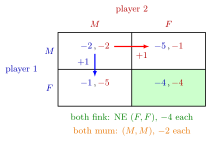
Start at mutual silence with each. Player 1 alone gains by finking (, blue arrow), and player 2 alone gains in the same way (red arrow); the same gain of appears in the other row and column, which is why is strictly dominant. When both follow this reasoning they end in the shaded equilibrium with each, which is worse for each player than the they could have had at .
The table starts with the payoffs above. Every orange arrow points towards , so is the only equilibrium, although both players prefer . Change the payoffs and watch the readout: once stops being strictly dominant for a player, or stops giving both players more than , the game is no longer a Prisoner's Dilemma.
The same structure appears in price competition (compare the Bertrand duopoly), arms races, contributions to public goods and the overuse of common resources. In those settings is usually called cooperate () and defect ().
The dilemma does not come from a lack of information or of communication. The game is a static game of complete information, so each player knows all payoffs; a promise to stay mum before the game does not change the fact that is better afterwards. Changing the outcome requires changing the game, for example through enforceable contracts or, later in the course, through repeated interaction.
The prediction is also unusually robust. Because is strictly dominant, a player needs no belief about the other player, and no assumption that the other is rational, to conclude that she should fink. In games such as the Battle of the Sexes, by contrast, each player's best choice depends on what she expects the other to do.
Compare it with the chicken game. There no action is dominant, mutual toughness is the worst outcome, and there are three equilibria. In the Prisoner's Dilemma mutual defection is bad but each player still prefers it to being the only one who cooperates, and there is a single equilibrium.
Key Results
- is the unique Nash equilibrium, and it is a strictly dominant strategy equilibrium.
- Iterated elimination of strictly dominated strategies removes for both players in the first round, because is a strictly dominated strategy.
- is Pareto dominated by ; the other three profiles are Pareto efficient. In the table, also has the largest total payoff, , against for one-sided finking and for .
- Both defining properties are needed. If mutual were not better for both than mutual , the unique equilibrium would be efficient and there would be no dilemma; if were not dominant, the game would no longer force .
- With mixed strategies (Week 2), is still the unique Nash equilibrium in mixed strategies, because a strictly dominated strategy gets probability in every equilibrium.
Looking ahead to Week 4: in a finitely repeated game with the Prisoner's Dilemma as stage game, the unique subgame-perfect Nash equilibrium plays in every period. In the infinitely repeated game, mutual cooperation can be sustained by the grim trigger strategy if the discount factor is large enough.
Examples
Solving the table above. For player 1,
so is strictly dominant, and by symmetry the same holds for player 2. The equilibrium is with payoffs , while gives .
Against any belief. Let player 1 believe that player 2 plays with probability . By expected payoff maximization she compares
so earns exactly more for every , and no belief about the other suspect makes staying mum a best response.
Changing the game. Suppose an enforceable agreement adds years to the sentence of a suspect who finks. The table becomes , , and . Now is strictly dominant ( and ), and is the unique Nash equilibrium. Any extra penalty above year has this effect; a penalty below year leaves dominant.
The cooperate–defect version (Week 4). The pages on repeated games use , , and . Defecting is strictly dominant ( and ), and beats the equilibrium payoff . When the game is repeated infinitely with discount factor , cooperating forever against grim trigger gives , while defecting at once gives . Cooperation is at least as good if and only if , that is,
Prerequisites
Related Concepts
- Iterated Elimination of Strictly Dominated Strategies
- Static Game of Complete Information
- Battle of the Sexes
- Chicken Game
- Repeated Game
- Grim Trigger Strategy
Sources
- Game Theory · Week 1 (placement provisional; not yet checked against the lecture slides)
Aliases: Prisoners' Dilemma, prisoners dilemma, PD, repeated Prisoner's Dilemma Keywords: Mum or Fink, cooperate or defect, dominant strategy equilibrium, social dilemma, individual versus collective rationality, Pareto-dominated equilibrium, conflict between individual and collective interest Symbols: delta, element of, infinity, sigma, sum
Last updated: 16 October 2026 22:28
Prisoner's DilemmaNormal-Form GameStrictly Dominant StrategyNash EquilibriumPareto EfficiencyIterated Elimination of Strictly Dominated StrategiesStatic Game of Complete InformationBattle of the SexesChicken GameRepeated GameGrim Trigger Strategy