Harsanyi Transformation
Method
The Harsanyi transformation turns a game of incomplete information (players unsure of each other's payoffs) into a game of complete but imperfect information that can be drawn as an extensive-form game:
- Add a non-strategic player, Nature, who moves first and draws the type profile according to the common prior .
- Reveal to each player only her own type : put into one information set of player all nodes that differ only in the others' types (and in moves she does not observe).
- Let the players then move as in the original game, with payoffs at the terminal nodes.
The resulting game, with the tree, and the information structure common knowledge, is the Bayesian game in extensive form.
Interpretation
Analysing a game in which players do not know each other's payoffs seems to need beliefs about beliefs about beliefs. The transformation replaces this regress by a single chance move whose probabilities everyone knows, so uncertainty about the game becomes uncertainty about Nature's move, which the theory of imperfect information already handles.
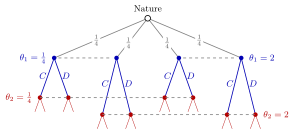
The figure draws the contribution game of the Examples, where its nodes and information sets are counted. Nature moves first and picks one of the four cost profiles, each with probability ; dashed lines join the nodes of one information set, at player 1's level and at player 2's.
A strategy in the transformed game assigns an action to every information set, that is, to every type: it is exactly a type-contingent strategy . A Nash equilibrium of the transformed game, with all types having positive probability, is a Bayesian Nash equilibrium.
The assumption that does the work is the common prior: Nature's probabilities must be the same for all players and common knowledge. Without it the players would disagree about Nature's probabilities, and there would be no single commonly known tree.
Key Results
- Player has one information set per type at each of her decision points, so her strategies are type-contingent plans.
- Because Nature's move is hidden from at least one player, the transformed game typically has few proper subgames. In the usual static representation, if every player information set is non-singleton, the whole game is the only subgame, so subgame perfection adds nothing to BNE. A sufficient case is at least two players, at least two types each, positive probability for every type profile, and each player observing only her own type. Counting types alone does not establish the information-set condition; zero-probability branches or types that reveal each other require checking the actual tree.
- Sequential games of incomplete information, such as the signalling game, are built the same way: Nature first, then moves with partially observed histories.
- The construction requires no change to payoffs; only the order of moves and the information sets are new.
Examples
Contribution game. Each of two players has cost , independently with probability , and chooses (contribute) or (decline) simultaneously.
- Nature has 4 branches, one per cost profile, each with probability .
- Player 1 then moves at 4 nodes; she knows but not , so the nodes form 2 information sets of 2 nodes each.
- Player 2 moves at nodes; she knows but sees neither nor player 1's action, so there are 2 information sets of 4 nodes each, one for and one for .
- There are terminal nodes, and each player has pure strategies.
Used cars. Nature draws the car's quality or ; the seller observes it, the buyer does not, so each pair of buyer decision nodes that follow "low" and "high" with the same observed seller behaviour forms one information set. This is the tree behind the market for lemons.
Prerequisites
Related Concepts
Sources
- Game Theory · Week 5
Aliases: Harsanyi's transformation Keywords: Nature moves first, chance move, incomplete to imperfect information, game tree with Nature, information sets over types Symbols: element of, theta
Last updated: 27 October 2026 11:52
Harsanyi TransformationBayesian GameExtensive-Form GameInformation SetBayesian Nash EquilibriumCommon PriorSubgameSignalling Game