Stage Game
Definition
A stage game is the simultaneous-move normal-form game
that is played once in every period of a repeated game, or in one stage of a multistage game. Here is the set of players, is player 's set of stage actions, is the set of action profiles and is player 's stage payoff. A Nash equilibrium of (pure or mixed) is called a stage-game Nash equilibrium.
Interpretation
The stage game is the building block; the repeated game adds time, observation of past play and a way of adding up payoffs. A strategy in the stage game is a single action, whereas a strategy in the repeated game is a whole plan that may condition on past play. The two must not be confused: an action profile that is not a stage-game equilibrium (cooperation in the Prisoner's Dilemma) can still be played on the equilibrium path of the repeated game.
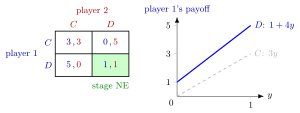
The left panel is the Prisoner's Dilemma stage game of the Examples, with , the unique stage-game Nash equilibrium, shaded. The right panel shows why: if player 2 plays with probability (a mixed strategy), player 1 earns from and from , and for every , so is her best response whatever player 2 does.
Stage-game equilibria are always available as credible continuation play, so they serve as rewards or punishments in the repeated game.
Key Results
- Playing a fixed stage-game Nash equilibrium in every period, whatever happened before, is a subgame-perfect equilibrium of the repeated game, finite or infinite, for every discount factor .
- If has a unique Nash equilibrium and is repeated finitely often, that history-independent repetition is the unique subgame-perfect equilibrium.
- The set of feasible payoffs used in the folk theorem is the set of convex combinations of the stage payoff vectors , .
Examples
Prisoner's Dilemma. With actions (cooperate) and (defect), take , , , . Since and , is a strictly dominant strategy, so is the unique stage-game equilibrium, although both players prefer ; the stage equilibrium is not Pareto efficient.
Prerequisites
Related Concepts
Sources
- Game Theory · Week 4
Aliases: constituent game, one-shot game, component game, base game Keywords: stage-game Nash equilibrium, stage payoff, v_i(a), repeated Prisoner's Dilemma Symbols: delta, element of, real numbers
Last updated: 17 October 2026 21:53
Stage GameMultistage GameRepeated GameNormal-Form GameNash EquilibriumMixed StrategyFolk TheoremGrim Trigger StrategyPrisoner's Dilemma