Rational Agent
Definition
A decision problem consists of a set of actions , a set of outcomes , a description of how each action leads to an outcome, and the decision maker's preference relation over , where means " is at least as good as ". The preference relation is assumed to be
- complete: for all , or (or both);
- transitive: and imply .
A payoff function represents if if and only if . Writing for the payoff of the outcome that action produces, a rational agent (rational player) knows the actions, the outcomes, how actions lead to outcomes and his or her own preferences, and chooses an action with
When actions lead to outcomes only with some probability, rationality means maximizing expected payoff.
Interpretation
Rationality is a modelling assumption about consistency, not about selfishness or money. The payoff may include altruism, fairness or effort costs; the assumption is only that choices maximize whatever the payoff measures. It turns the choice into an optimization model, which is what makes behaviour predictable.
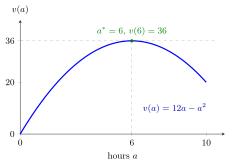
The figure draws the study-hours example. The rational choice is an action whose payoff is at least that of every other action: the whole graph of on lies on or below the line , which it touches only at . Replacing by would change the heights but not the location of the maximum, so the choice is the same.
Completeness rules out "cannot compare"; transitivity rules out preference cycles, for which no best element exists.
In a game, the outcome also depends on the other players, so a rational player maximizes given a belief about their choices. Rationality alone does not say which belief is reasonable; that needs further assumptions such as common knowledge of rationality or the correct beliefs built into Nash equilibrium.
Key Results
- On a finite set , a complete and transitive preference relation can always be represented by a payoff function.
- If represents and is strictly increasing, then represents the same preferences and gives the same choice under certainty. Under uncertainty only positive affine transformations , , are guaranteed to preserve choices (see expected payoff maximization).
- With finite and nonempty an optimal action always exists. With infinite it may not: on with the supremum is not attained.
- In a game, a rational player's choice given a belief about the others is a best response to that belief.
Examples
Continuous action. A student chooses study hours with payoff (benefit minus effort cost). Since is zero at and , the rational choice is with . The payoff represents the same preferences and gives the same .
Cycle. Suppose , and (strict preferences). Whichever of the three outcomes is chosen, another is strictly preferred, so no choice is optimal. Transitivity excludes this.
Firm. A firm that believes its rival will produce units chooses its own output to maximize profit given that belief; in a Cournot duopoly this choice is its best response.
Prerequisites
Related Concepts
Sources
- Game Theory · Week 1
Aliases: rational player, rational decision maker, rationality, rational actor Keywords: decision problem, preference relation, complete and transitive preferences, payoff function v(a), homo economicus Symbols: alpha, beta, element of, real numbers
Last updated: 27 October 2026 11:52
Rational AgentBackward InductionBest ResponseCommon KnowledgeExpected Payoff MaximizationGame TheoryStrictly Dominated StrategyOptimization ModelFunction