Strictly Dominated Strategy
Definition
In a normal-form game , let be two strategies of player . Strategy strictly dominates if, for every ,
Then is strictly dominated (by ). A strategy is strictly dominated if at least one other strategy of the same player strictly dominates it.
Interpretation
A strictly dominated strategy is worse than some alternative whatever the other players do. A rational agent therefore never plays it, and this conclusion needs no knowledge of the other players' rationality or beliefs.
Two conditions must hold together: the comparison is against one fixed alternative , and the inequality is strict for every . A single tie is enough to break strict dominance; the strategy may then still be weakly dominated, which is a different and weaker notion (see weakly dominant strategy, Week 6).
A common error is to call dominated because it is never the best choice in any column. Being worse than different strategies in different columns is not strict dominance by a pure strategy (Example 2).
Key Results
- A strictly dominated strategy is never a best response, neither to any nor to any probabilistic belief about , because the dominating strategy gives a strictly higher payoff in every case and hence a strictly higher expected payoff.
- Strict dominance is transitive: if strictly dominates and strictly dominates , then strictly dominates .
- Removing strictly dominated strategies never removes a strategy used in a Nash equilibrium; repeating the removal gives iterated elimination of strictly dominated strategies.
- A strategy that is not dominated by any pure strategy can still be strictly dominated by a mixed strategy (Week 2).
Examples
1. Prisoner's Dilemma. With the payoffs of the normal-form game page, for player 1:
so Mum is strictly dominated by Fink. By symmetry the same holds for player 2.
2. Not dominated by a pure strategy. Player 1's payoffs (player 2 chooses or ):
is not dominated by ( against ) nor by ( against ). Yet the mixture " and with probability each" gives against both columns, so is strictly dominated by a mixed strategy.
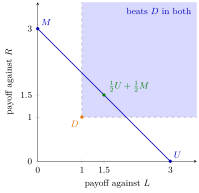
In the figure, each strategy of player 1 is a point (payoff against , payoff against ), and the shaded region contains the points that beat in both columns. Neither nor lies in it, but the segment between them consists of their mixtures, and its midpoint does.
Slide along the segment of mixtures of and : the green part beats against both columns. Drag beyond the segment and no mixture dominates it any more.
3. A tie. If in the Prisoner's Dilemma were changed to , then and would tie against , and would no longer be strictly dominated.
Prerequisites
Related Concepts
- Strictly Dominant Strategy
- Iterated Elimination of Strictly Dominated Strategies
- Weakly Dominant Strategy
- Mixed Strategy
Sources
- Game Theory · Week 1
Aliases: strict dominance, strictly dominated action Keywords: strictly dominates, dominated strategy, s_i' strictly dominates s_i, never a best response, domination by a mixed strategy, Prisoner's Dilemma Symbols: alpha, element of
Last updated: 22 October 2026 19:04
Strictly Dominated StrategyForward InductionIterated Elimination of Strictly Dominated StrategiesStrictly Dominant StrategyNormal-Form GameRational AgentWeakly Dominant StrategyMixed Strategy