Strategy in an Extensive-Form Game
Definition
Let be the collection of player 's information sets in an extensive-form game, and the actions available at . A pure strategy of player is a function that assigns to every an action . It is a complete contingent plan: it specifies what does at every information set at which she could move, including information sets that are not reached when the strategy profile is played.
The set of pure strategies is . A mixed strategy is a probability distribution over ; a behavioural strategy instead specifies an independent probability distribution over at each information set .
Interpretation
A strategy is a full set of instructions that someone could carry out on the player's behalf without consulting her again, whatever happens. It is different from an action (one choice at one information set) and from an outcome (the path actually played).
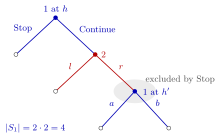
The figure draws the example of a player who moves twice. Player 1 has two information sets, with actions Stop and Continue and with actions and , so has elements. The shaded node cannot be reached after Stop, yet every strategy still names an action there: (Stop, ) and (Stop, ) produce the same play but are different plans.
The plan must cover information sets that are not reached, and even ones that the player's own earlier choices exclude. The reason is that equilibrium analysis asks what would happen after a deviation: whether the entrant should enter depends on what the incumbent would do after entry, even if entry does not occur. Two profiles can produce the same path and differ only off the path; this is how a non-credible threat can support a Nash equilibrium that is not subgame perfect.
The same idea returns in repeated games, where a strategy assigns an action to every history.
Key Results
- Player has pure strategies.
- A pure-strategy profile determines a unique path from the root to a terminal node (given Nature's moves, a probability distribution over terminal nodes), which yields the normal-form payoffs.
- The pure strategies of the induced normal-form game are exactly these plans; in a static game, where each player has a single information set, a strategy is just an action.
- Profiles that agree on the path of play give the same payoffs, whatever they prescribe off the path.
- Under perfect recall, every mixed strategy has an outcome-equivalent behavioural strategy and vice versa (Kuhn's theorem).
Examples
Entry game. The incumbent has one information set (after In) with actions Accommodate and Fight, so her strategies are . In the profile (Out, ) the incumbent never moves, yet her strategy is what deters entry.
Sequential Battle of the Sexes. Player 2 observes player 1's choice of or . Her strategies are written (reply to , reply to ): , , , . "Always match" is ; "always choose " is .
A player who moves twice. Player 1 chooses Stop or Continue. After Continue, player 2 chooses or ; after , player 1 chooses or . Player 1 has strategies: (Stop, ), (Stop, ), (Continue, ), (Continue, ). The plans (Stop, ) and (Stop, ) produce the same play, but they are different strategies because they differ at an information set that Stop excludes. Player 2 has strategies.
Prerequisites
Related Concepts
- Mixed Strategy
- Subgame-Perfect Nash Equilibrium
- Backward Induction
- History in a Multistage Game
- Grim Trigger Strategy
- Equilibrium Path
Sources
- Game Theory · Week 3
Aliases: extensive-form strategy, complete contingent plan, pure strategy in an extensive-form game Keywords: contingent plan, off-path behaviour, behavioural strategy, behavioral strategy, number of strategies, Kuhn's theorem, entry game, Battle of the Sexes Symbols: element of, product
Last updated: 17 October 2026 21:53
Strategy in an Extensive-Form GameBackward InductionDutch AuctionEquilibrium PathHistory in a Multistage GameSubgame-Perfect Nash EquilibriumExtensive-Form GameInformation SetPure StrategyMixed StrategyGrim Trigger Strategy