Common Knowledge
Definition
Let be a fact (an event) concerning the players of a game. Define the levels of knowledge recursively:
- : every player knows (mutual knowledge);
- : every player knows that holds, for
The fact is common knowledge among the players if holds for every : everyone knows , everyone knows that everyone knows , and so on at every finite level.
Common knowledge of rationality is the case where is the statement "every player is a rational agent".
Interpretation
In game theory a player's best choice depends on what the others will do, which depends on what they believe, including what they believe about this player. Common knowledge closes this chain of "beliefs about beliefs" by assuming that every level holds.
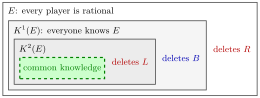
The figure draws each level as a smaller set of situations: a situation where holds also satisfies and , but not the other way round. Further levels would be drawn as more boxes inside ; common knowledge is what lies inside all of them. The labels follow Example 1 below: rationality of player 2 alone deletes , knowing that player 2 is rational lets player 1 delete , and the second level lets player 2 delete .
The main misunderstanding is to treat common knowledge as "everyone knows". Mutual knowledge does not imply : each player may know without knowing that the others know it.
Two standard assumptions use the concept. In a static game of complete information the players, strategy sets and payoff functions are common knowledge. Common knowledge of rationality justifies iterated elimination of strictly dominated strategies (Key Results).
Key Results
- Common knowledge of implies for every ; no finite level implies common knowledge.
- Deleting a strictly dominated strategy in round needs only rationality of its owner. A deletion in round needs rationality together with levels of "everyone knows that ..." about rationality. Common knowledge of rationality therefore supports the whole elimination process, for as many rounds as needed.
- Common knowledge of rationality does not by itself select a Nash equilibrium: in Battle of the Sexes no strategy is eliminated, and players can still fail to coordinate.
- In a Bayesian game (Week 5) the common prior over types is assumed to be common knowledge.
Examples
1. Levels of rationality. Player 1 chooses or , player 2 chooses , or ; payoffs are .
- Player 2 is rational: is strictly dominated by ( and ), so is not played.
- Player 1 is rational and knows player 2 is rational: without , beats .
- Player 2 is rational, knows player 1 is rational, and knows that player 1 knows player 2 is rational: given , beats .
The prediction uses rationality plus two levels of knowledge about rationality.
2. Private versus public. Each of two players is told privately that a meeting is at 9:00. Both know the time (), but neither knows that the other knows. If the time is announced to both together, each sees the other hear it, and the time becomes common knowledge.
Prerequisites
Related Concepts
- Static Game of Complete Information
- Iterated Elimination of Strictly Dominated Strategies
- Common Prior
- Nash Equilibrium
Sources
- Game Theory · Week 1
Aliases: CK Keywords: common knowledge of rationality, everyone knows that everyone knows, mutual knowledge, higher-order knowledge, K^m(E), public announcement
Last updated: 14 October 2026 16:25
Common KnowledgeBackward InductionCommon PriorExtensive-Form GameIterated Elimination of Strictly Dominated StrategiesStatic Game of Complete InformationTypeRational AgentGame TheoryNash Equilibrium