Common-Value Auction
Definition
In a common-value auction the object has the same value for every bidder, but no bidder knows . Each bidder privately observes a signal that is informative about , and her payoff from winning at price is . Bidder 's expected value therefore depends on the other bidders' signals as well as on her own.
A two-bidder example with this structure has , where bidder observes only her own component , and are independent.
Interpretation
The contrast with a private-value auction is about information, not about who values the object more. With private values, learning a rival's signal would not change one's own valuation; with a common value it would. Classic examples are drilling rights to an oil field of unknown size, or a jar of coins whose total is estimated by eye.
Because the value is shared, winning is itself informative: a bidder wins in a symmetric equilibrium when her signal is the highest, which is bad news about the others' signals. A rational bidder therefore bids on the basis of the conditional expectation of given her signal and given that she wins (or, in a second-price auction, given that she is just tied). Ignoring this produces the winner's curse.
Truthful bidding results for private values do not carry over directly. In a second-price auction the case argument for bidding "one's value" fails, because one's value is not known; the equilibrium bid must instead be computed as a Bayesian Nash equilibrium.
Key Results
- In a symmetric equilibrium with increasing bids, overstates what a bidder can expect when she wins; the relevant quantity is .
- For with i.i.d. : the symmetric BNE of the second-price auction is , and that of the first-price auction is .
- In that example both formats give expected revenue .
- The Dutch–first-price equivalence holds with common values; the English–second-price equivalence can fail with three or more bidders, because drop-out prices reveal signals.
Examples
Take with independent and uniform on .
Second-price. Let bidder 2 bid . Bidder 1 with signal who bids wins when and pays , so her expected payoff (written because is the common value) is
The integrand is positive for and negative for , so the payoff is maximized at , i.e. . Revenue is .
First-price. Let bidder 2 bid . Bidder 1 with signal bidding wins when , with expected payoff
maximized at . Revenue is .
Numbers. With , , but . The first-price bid leaves an expected margin of when winning.
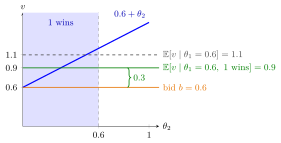
The figure fixes bidder 1's signal at , so the value is . Averaged over all it is , but in the first-price equilibrium bidder 1 wins only in the shaded region , where the average value is . A bid computed from would overpay on average, which is the winner's curse; the equilibrium bid sits below the conditional value.
Move the bid : a winning bid means , so it buys only the green average value. The naive bid overpays, while maximizes the expected payoff.
Prerequisites
- Private-Value Auction
- Bayesian Nash Equilibrium
- Conditional Expectation Given an Event
- Uniform Distribution
Related Concepts
Sources
- Game Theory · Week 6
Aliases: Common Value Auction, pure common-value auction, common-values auction Keywords: private signal, interdependent values, wallet game, v = theta_1 + theta_2, conditioning on winning Symbols: integral, theta
Last updated: 22 October 2026 19:04
Common-Value AuctionWinner's CursePrivate-Value AuctionBayesian Nash EquilibriumConditional Expectation Given an EventUniform DistributionSecond-Price AuctionFirst-Price AuctionEnglish Auction