Subgame
Definition
In an extensive-form game , a subgame consists of a single decision node together with all of its successors, with the property that whenever a node belongs to it, every node in the same information set as also belongs to it. The subgame inherits the players, actions, information sets and payoffs of .
Equivalently: a subgame starts at a node whose information set is the singleton , contains everything that follows , and does not cut through any information set. The whole game (starting at the root) is always a subgame.
A subgame other than itself is a proper subgame, in the same sense as a proper subset: the whole game is a subgame, but not a proper subgame. When counting, say whether the whole game is included.
Interpretation
A subgame is a part of the game that can be analysed as a game in its own right: once play reaches , every player knows that it has, and everything relevant for the continuation is contained in the subgame. This is what makes it meaningful to require Nash equilibrium behaviour in it, as subgame-perfect Nash equilibrium does.
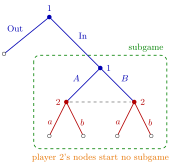
In the figure (the outside-option example below), the node after In is a singleton, and the outlined part below it contains both nodes of player 2's information set, so it is a subgame. Neither of player 2's nodes can start a subgame: a part starting there would separate the two nodes of one information set. Together with the whole game, the tree has subgames, one of them proper.
Two conditions are often overlooked. First, a node inside a non-singleton information set cannot start a subgame, because the mover there does not know she is at that node. Second, the requirement applies to all successors: a candidate subgame that contains one node of an information set but not another is not a subgame, even if it starts at a singleton.
Subgames are defined by the tree, not by the strategies played: a subgame off the equilibrium path is still a subgame.
Key Results
- Every game is a subgame of itself, but not a proper subgame of itself.
- In a finite game of perfect information, every decision node starts a subgame, so the number of subgames equals the number of decision nodes.
- A simultaneous-move game written as a tree has no proper subgames.
- If has no proper subgames, its subgame-perfect equilibria are exactly its Nash equilibria.
- A profile of strategies of restricts to a strategy profile of every subgame (keep the prescriptions at information sets inside the subgame).
Examples
Entry game. The entrant chooses Out or In; after In the incumbent chooses Accommodate or Fight. There are two decision nodes, both singletons, so there are subgames: the whole game and the incumbent's decision after In, which is the only proper subgame.
Sequential Battle of the Sexes. Player 1 moves; player 2 observes and moves. Subgames: the whole game and one for each of player 2's two nodes, so in total, of them proper. In the simultaneous version, player 2's two nodes form one information set, and the only subgame is the whole game.
Outside option followed by a simultaneous game. Player 1 chooses Out (game ends) or In. After In, player 1 chooses or and player 2, without observing this, chooses or . The node after In is a singleton and all its successors, including both nodes of player 2's information set, lie below it, so it starts a subgame. Player 2's nodes cannot start subgames. The game has subgames, one of them proper.
Prerequisites
Related Concepts
- Subgame-Perfect Nash Equilibrium
- Backward Induction
- One-Stage Deviation Principle
- Repeated Game
- Equilibrium Path
Sources
- Game Theory · Week 3
Aliases: proper subgame, subgames Keywords: continuation game, does not cut an information set, counting subgames, singleton information set, entry game, Battle of the Sexes, outside option Symbols: gamma
Last updated: 16 October 2026 22:28
SubgameHistory in a Multistage GameSubgame-Perfect Nash EquilibriumExtensive-Form GameInformation SetBackward InductionOne-Stage Deviation PrincipleRepeated GameEquilibrium Path