Information Set
Definition
In an extensive-form game, an information set of player is a nonempty set of decision nodes such that
- player moves at every node of ;
- when play reaches a node of , player knows only that some node of has been reached, not which one;
- the same set of actions is available at every node of .
Player 's information sets form a partition of all the decision nodes at which she moves. An information set with one node is a singleton. The game has perfect information if and only if every information set is a singleton.
Interpretation
An information set records what a player has observed. With perfect recall, nodes are grouped together when they differ only in events the player did not see, for example a rival's earlier move or a move of Nature. If recall is imperfect, grouped nodes may also differ in a forgotten own action or observation. In a tree diagram they are joined by a dashed line or enclosed in an oval.
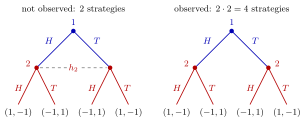
The figure draws the Matching Pennies example, with payoff to the winner and to the loser (player 2 wins when the coins differ). On the left, player 2 cannot tell after which coin she moves, so both nodes lie in one information set and she picks one action for the whole set: strategies, exactly the simultaneous game. On the right the dashed line is gone, each node is its own information set, and she has strategies, including the one that always wins.
Condition 3 is needed for consistency: if the available actions differed between two nodes, the player could tell the nodes apart from her options. For the same reason a player cannot condition her action on the node within an information set; she chooses one action for the whole set.
It is usually assumed that players have perfect recall: they never forget their own earlier actions or what they observed before. Information sets must then never merge nodes that the player could already distinguish.
A common confusion is between an information set and a subgame. A subgame starts at a single node; an information set with several nodes describes uncertainty and can neither start a subgame nor be split by one. Beliefs weight continuation payoffs at a non-singleton information set when checking sequential rationality; the choice may be independent of the belief when one action is best at every node.
Key Results
- A pure strategy of player assigns one action in to every information set of player ; her number of pure strategies is .
- Every simultaneous-move normal-form game can be written as an extensive-form game in which later movers have a single information set covering all nodes that follow the earlier moves.
- Merging two singleton information sets into one (removing an observation) reduces the number of strategies; for two nodes with actions each, from to .
- A subgame never starts at a node of a non-singleton information set and never contains only part of an information set.
- At a non-singleton information set, expected payoffs use a belief over its nodes, and the optimal action can depend on that belief (system of beliefs).
Examples
Matching Pennies drawn as a tree. Player 1 chooses or ; player 2 then chooses or without observing player 1. Player 2's two decision nodes form one information set, so she has strategies and the game is exactly the simultaneous one. If player 2 does observe player 1's coin, she has two singleton information sets and strategies, written as (action after , action after ). Since player 2 wins when the coins differ, the strategy ( after , after ) wins every time.
Counting strategies. A player with three information sets offering , and actions has pure strategies, even if some of these information sets are never reached in a particular play.
Uncertain entrant. An incumbent sees that entry occurred but not whether the entrant is "ready" or "unready". Both nodes lie in one information set, so the incumbent's choice of Fight or Accommodate must be the same at both, and its value depends on the probability she assigns to each node.
Prerequisites
Related Concepts
- Strategy in an Extensive-Form Game
- Subgame
- Sequential Rationality
- System of Beliefs
- Perfect Bayesian Equilibrium
Sources
- Game Theory · Week 3
Aliases: information sets, info set Keywords: h_i, singleton information set, perfect information, imperfect information, dashed line in game tree, perfect recall, Matching Pennies Symbols: product
Last updated: 27 October 2026 11:52
Information SetEquilibrium PathHarsanyi TransformationSequential RationalityStrategy in an Extensive-Form GameSubgameSystem of BeliefsExtensive-Form GamePure StrategyPerfect Bayesian Equilibrium