Compound Risk Distribution
Definition
The distribution of is a compound distribution when is a nonnegative integer variable and the are i.i.d. severities independent of . Let and .
Interpretation
Compounding combines uncertainty in the number of claims with uncertainty in their sizes. It differs from mixing a parameter of one distribution.
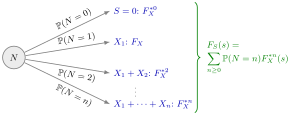
The figure reads the formula for as a two-stage experiment. The count is drawn first, with probability for each branch; given , the loss is a sum of independent severities, whose law is the -fold convolution (and when ). Averaging the branch laws with the branch probabilities gives . In the Bernoulli Example only the branches and remain, with weights and , which is why the result is a simple mixture.
The collective risk model supplies the random-sum assumptions. Given , convolution of independent random variables gives , and the probability generating function averages transform powers over the count. Adam’s law: total expectation applied to gives the mean. The conditioning trick for variance combines with variation in to give the two variance terms.
Key Results
- .
- , with finite second moments.
- With moment generating function (MGF) and PGF , where the expression is finite; for integer severities .
- , with the cumulative distribution function of the constant zero.
Examples
If is Bernoulli with probability , then is zero with probability and otherwise has the severity law. Thus a compound Bernoulli model is also a simple mixture.
Prerequisites
- Collective Risk Model
- Probability Generating Function
- Convolution of Independent Random Variables
- Adam’s Law: Total Expectation
- Conditioning Trick for Variance
Related Concepts
Sources
- Risk Insurance · Lecture 4
Aliases: random sum distribution, compound frequency-severity distribution, compound distribution, random sum, compound sum, stopped-sum distribution Keywords: E[S] = E[N] μ, Var(S) = E[N] σ^2 + Var(N) μ^2, M_S(t) = G_N(M_X(t)), n-fold convolution, compound Bernoulli Symbols: mu, sigma, sum
Last updated: 17 October 2026 21:53
Compound Risk DistributionCompound Poisson DistributionRisk Orders Under AggregationCollective Risk ModelProbability Generating FunctionConvolution of Independent Random VariablesAdam’s Law: Total ExpectationConditioning Trick for VarianceMixture Distribution