Maximum Claim in a Portfolio
Definition
For nonnegative i.i.d. severities independent of count , the maximum claim is , with if . Let be the severity cumulative distribution function (CDF) and the count probability generating function (PGF).
Interpretation
Aggregate loss and maximum claim measure different exposures. Conditioning on the count reduces the maximum to the probability that every claim is at most a chosen threshold.
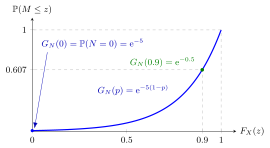
The figure plots for as a function of , the probability that a single claim is at most . In the example a claim exceeds 1000 with probability , so and the probability that no claim exceeds 1000 is . At the curve starts at , the chance of no claims at all, and it reaches 1 at . The steep rise near shows how strongly the maximum depends on the single-claim tail when several claims are expected.
The collective risk model supplies a random claim count and independent common severities. To study the maximum rather than their sum, condition on the same count: all claims are at most with probability .
Key Results
- For , .
- If , .
- With fixed count , this becomes .
- The no-claim convention matters at zero and when evaluating moments.
Examples
With Poisson mean 5 and probability that one claim exceeds 1000, the probability that no claim exceeds 1000 is .
Prerequisites
Related Concepts
Sources
- Risk Insurance · Lecture 4
Aliases: largest claim size, maximum of a random number of claims, maximum claim, largest claim Keywords: P(M ≤ z) = G_N(F_X(z)), exp(-λ(1 - F_X(z))), probability that no claim exceeds a threshold Symbols: lambda
Last updated: 27 October 2026 11:52
Maximum Claim in a PortfolioProbability Generating FunctionCollective Risk ModelCumulative Distribution FunctionCompound Poisson DistributionCompound Poisson Process