Second-Order Stochastic Dominance
Definition
For nonnegative integrable gain or wealth variables , has second-order stochastic dominance over if for every . Equivalently, every increasing concave utility weakly prefers to , with expectations defined.
Interpretation
This comparison is stated for favourable outcomes. When the variables denote losses, put the minus sign inside wealth utility. A larger mean alone does not establish second-order dominance.
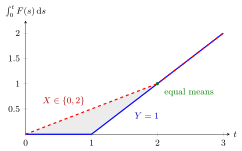
The figure reads the Examples case as gains: is the fair draw of 0 or 2 and is certain. Then for , while there; the shaded gap shows that the first integral is never below the second, which is the definition of dominating in second order. From on both integrals equal , because once exceeds every outcome the integral equals minus the mean, and the means are equal.
Convex order and more dangerous risks compares dispersion at equal means. In that case makes every concave utility prefer the gain , explaining the direction of the equal-mean second-order comparison.
Key Results
- First-order dominance of over implies second-order dominance.
- Dominance requires for integrable variables.
- At equal means, dominating in second order corresponds to .
- For losses, corresponds to preference for wealth over by increasing concave utility.
Examples
As gains, a certain 1 second-order dominates a fair draw of 0 or 2. As losses, the same certain 1 is the less dangerous risk. The preference direction is the same after the outcome meaning is specified.
Prerequisites
Related Concepts
Sources
- Risk Insurance · Lecture 10
Aliases: increasing concave order, second-order dominance of wealth, SSD, second-order dominance, second-degree stochastic dominance Keywords: integrated CDF, increasing concave utility, ∫_0^t F_X(s) ds ≥ ∫_0^t F_Y(s) ds, risk-averse preference, gains versus losses Symbols: integral
Last updated: 17 October 2026 21:53
Second-Order Stochastic DominanceExpected Utility and Risk AversionConvex Order and More Dangerous RisksStochastic OrderStop-Loss Order