Likelihood for Truncated Loss Data
Definition
Under left truncation at , only losses satisfying enter the dataset. For independent exact observations drawn from that conditional population, the likelihood contribution is for , provided .
Interpretation
Small losses are absent altogether. The likelihood must renormalize the observed population; this differs from retaining small losses as censored observations.
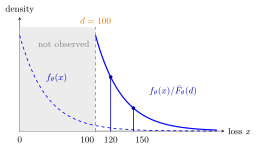
The figure uses the fitted rate from the Examples case. The dashed ground-up density puts almost all of its mass below , where nothing is recorded. Dividing by lifts the part above 100 into a proper density on , and the observations 120 and 150 contribute its heights to the likelihood. For the exponential law this conditional density is the original one shifted to start at , which is why only the excesses 20 and 50 enter the estimate.
An ordinary deductible produces a dataset of paid claims only when the loss exceeds . If recorded amounts are excesses, add back before evaluating the ground-up density, and divide by the exceedance probability to describe the selected population.
Key Results
- for a fixed observed sample size.
- For observation restricted to , normalize by .
- If a deductible dataset reports excesses , use .
- Information about the total number of excluded losses would require an additional sampling model.
Examples
For exponential losses observed only above 100, observations 120 and 150 have excesses 20 and 50. The conditional maximum likelihood estimate (MLE) is , rather than .
Prerequisites
Related Concepts
Sources
- Risk Insurance · Lecture 5
Aliases: left truncation, deductible-conditioned sampling, truncated likelihood, truncated data likelihood, left-truncated data Keywords: f_θ(x_i)/F̄_θ(d), deductible data, excesses over the deductible, conditional MLE Symbols: sum, theta
Last updated: 17 October 2026 21:53
Likelihood for Truncated Loss DataMaximum Likelihood EstimationOrdinary DeductibleLikelihood for Censored Loss DataLikelihood for Grouped Loss Data