Insurance Indifference Premiums
Definition
For initial policyholder wealth , strictly increasing utility and full insurance of loss , the maximum acceptable premium solves . For insurer wealth and strictly increasing utility , its minimum acceptable premium solves , when finite solutions exist.
Interpretation
One equation compares insured and uninsured wealth for the customer; the other compares taking the contract with taking no risk for the insurer. A trade is acceptable to both when the premium lies between their thresholds.
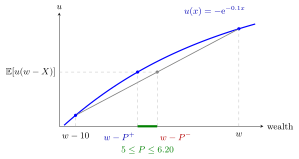
The figure draws the Examples case with . The chord midpoint is the expected utility of the uninsured position, and the wealth on the curve with the same utility is , with . Because is concave, this point lies to the left of . For a risk-neutral insurer , so every premium in the green range from 5 to 6.20 is acceptable to both parties.
Absolute risk aversion measures the local curvature of the utility used in each indifference equation. For exponential utility it is the constant , so the example's coefficient specifies how strongly large losses affect the acceptable premium.
Key Results
- Under concavity and well-defined expectations, and .
- A mutually acceptable full-insurance premium exists if .
- A risk-neutral insurer has in this expense-free model.
- Exponential utilities with different coefficients produce different thresholds; finiteness requires the respective exponential loss moments.
Examples
For exponential utility parameter and loss 0 or 10 with equal probabilities, the indifference premium is , where is the natural logarithm. At it is about 6.20, above mean loss 5.
Prerequisites
Related Concepts
Sources
- Risk Insurance · Lecture 8
Aliases: maximum acceptable premium, minimum insurer premium, certainty equivalent loss, indifference premium, utility indifference premium, minimum acceptable premium Keywords: u(w - P+) = E[u(w - X)], U(W) = E[U(W + P- - X)], range of acceptable premiums, exponential utility Symbols: alpha
Last updated: 17 October 2026 21:53
Insurance Indifference PremiumsExponential Premium PrincipleZero-Utility PremiumExpected Utility and Risk AversionAbsolute Risk Aversion