Compound Poisson Distribution
Definition
A compound Poisson loss is with , , and i.i.d. nonnegative severities independent of . The empty sum is zero.
Interpretation
Poisson frequency makes aggregate losses particularly tractable. Even with continuous positive severities, aggregate loss includes a probability of no claims at all.
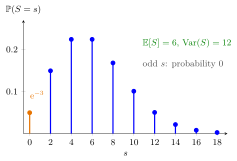
The figure plots the Example's loss with , so . The orange bar at zero is the no-claim probability , present even though every claim is positive. The mass sits only on even values, and the mean and variance follow from the Key Results; a Poisson variable with mean 6 would have variance 6.
This specializes the compound risk distribution by choosing the count from the Poisson distribution. Since its count mean and variance both equal , the general random-sum variance simplifies to .
Key Results
- and when finite.
- The moment generating function (MGF) satisfies where finite.
- With strictly positive severity, .
- Claim counts for disjoint severity categories are independent Poisson variables with rates (with the probability that a claim falls in category ); this uses the Poisson splitting result.
Examples
If each claim is 2 and , then has mean 6 and variance 12. Its support is , so it is not an ordinary Poisson variable.
Prerequisites
Related Concepts
- Superposition of Compound Poisson Risks
- Compound Poisson Process
- Poisson Splitting
- Collective Risk Model
- Cumulant Generating Function
- Maximum Claim in a Portfolio
- Risk Orders Under Aggregation
Sources
- Risk Insurance · Lecture 4
Aliases: compound Poisson aggregate loss, compound Poisson, compound Poisson random variable Keywords: Poisson frequency model, M_S(t) = exp(λ(M_X(t) - 1)), Var(S) = λ E[X^2], no-claim probability e^(-λ), Poisson splitting by claim category Symbols: lambda, sum
Last updated: 17 October 2026 21:53
Compound Poisson DistributionCompound Poisson ProcessSuperposition of Compound Poisson RisksCompound Risk DistributionPoisson DistributionPoisson SplittingCollective Risk ModelCumulant Generating FunctionMaximum Claim in a PortfolioRisk Orders Under Aggregation