Individual Risk Model
Definition
The individual risk model represents total portfolio loss by , where is the fixed number of policies and is the loss from policy , including zero for a claim-free policy. The basic course model assumes independent policy losses, often identically distributed.
Interpretation
The model counts policies first and models the loss outcome of each. Its summands may have an atom at zero even when positive claim amounts are continuous.
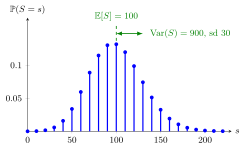
The figure draws the Examples portfolio. Each of the 100 policies has an atom at 0 (no claim, probability 0.9) and loses 10 otherwise, so the total takes only multiples of 10. Adding the 100 independent policy means and variances gives and , a standard deviation of 30.
An indicator random variable records whether policy claims and switches the claim severity on in . Independent random variables allow policy variances to add. Convolution of independent random variables supplies the aggregate distribution by combining the policy-loss laws.
Key Results
- With independence, and .
- For with independent Bernoulli indicator of probability and severity , the mean is .
- Its variance is .
- Dependence between policies adds covariance terms to portfolio variance.
Examples
For 100 independent policies with claim probability and fixed claim 10, with . Mean is 100 and variance is 900.
Prerequisites
Related Concepts
Sources
- Risk Insurance · Lecture 3
Aliases: fixed-policy portfolio model, policy-level aggregate loss, individual model Keywords: X_i = I_i B_i, Bernoulli claim indicator, fixed number of policies, S = X_1 + ... + X_n, compound Poisson approximation Symbols: sum
Last updated: 16 October 2026 22:28
Individual Risk ModelCollective Risk ModelPoint MassIndicator Random VariableIndependent Random VariablesConvolution of Independent Random VariablesBernoulli DistributionMixed Discrete and Continuous Loss DistributionRisk Orders Under Aggregation