Maximum Likelihood Estimation
Definition
Given a specified family of observation laws indexed by parameter , a maximum likelihood estimate maximizes the likelihood of the observed data. For independent exact observations , , where is the applicable density or mass function.
Interpretation
The parameter varies while the observations remain fixed. Insurance data may report intervals or censoring rather than exact losses, so the likelihood must describe what was actually observed.
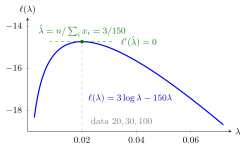
As an illustration, take the three exact losses 20, 30 and 100, so and . The data stay fixed and the exponential log-likelihood is drawn as a function of the parameter. It is concave, its derivative vanishes at , and that zero is the maximum because , as in the general example below.
The independent random variables assumption makes the joint observation density or mass function a product. Taking its logarithm then gives the sum of individual log contributions used for estimation.
Key Results
- Maximizing is equivalent to maximizing where .
- For independent observations, .
- A zero derivative identifies a candidate, not automatically a maximum. Check the parameter domain, boundaries and curvature or numerical objective.
- Grouping, censoring and truncation require different observation contributions.
Examples
For positive i.i.d. exponential losses with rate , , so . The second derivative is .
Prerequisites
Related Concepts
- Likelihood for Grouped Loss Data
- Likelihood for Censored Loss Data
- Likelihood for Truncated Loss Data
Sources
- Risk Insurance · Lecture 4
Aliases: MLE, log-likelihood maximisation, maximum likelihood, maximum likelihood estimator, maximum likelihood estimate, ML estimation, method of maximum likelihood Keywords: likelihood function, log-likelihood, zero derivative of the log-likelihood, exponential rate n / Σx_i, second-order condition Symbols: element of, lambda, product, sum, theta
Last updated: 17 October 2026 21:53
Maximum Likelihood EstimationLikelihood for Censored Loss DataGeneralized Linear ModelLikelihood for Grouped Loss DataInformation Criteria for Risk ModelsLikelihood for Truncated Loss DataProbability Density FunctionIndependent Random VariablesProbability Mass Function