Exposure Offset in Claim-Frequency Models
Definition
For positive exposure and claim rate , a Poisson frequency model specifies . Therefore . The known term is an offset, with coefficient fixed at one.
Interpretation
A group with twice as much insured time should have twice the expected claim count if its underlying claim rate is unchanged. The offset lets rating coefficients describe rate differences.
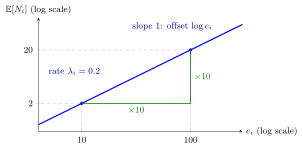
The figure draws the Examples case with rate per policy-year. On log scales, is a straight line whose slope in is fixed at 1 by the offset, while the rating term only sets its height. Multiplying exposure by 10, from 10 to 100, multiplies the expected count by 10, from 2 to 20, so the fitted rate stays 0.2.
Poisson regression relates the logarithm of an expected count to rating predictors. Exposure changes that count mean from to , so its logarithm adds the known offset without estimating an extra coefficient.
Key Results
- Expected count is ; fitted rate is count mean divided by .
- An offset differs from an estimated covariate coefficient.
- Exposure must be positive and measured in a consistent unit.
- A zero-exposure record requires separate treatment; is undefined.
Examples
At rate 0.2 per policy-year, exposures 10 and 100 have expected counts 2 and 20. Both have the same fitted rate.
Prerequisites
Related Concepts
Sources
- Risk Insurance · Lecture 6
Aliases: log exposure offset, Poisson regression with exposure, exposure offset, offset term Keywords: log e_i, exposure in policy-years, claim rate per unit exposure, coefficient fixed at one Symbols: beta, lambda
Last updated: 14 October 2026 08:21
Exposure Offset in Claim-Frequency ModelsRating Factors and Interactions in Insurance GLMsPoisson RegressionOverdispersion in Count Models