Franchise Deductible
Definition
With a franchise deductible , the insurer pays the entire loss once it exceeds : . If , payment is zero. Conditional on a payment, the paid amount has the law of .
Interpretation
The threshold decides whether the insurer pays, but is not deducted from a qualifying loss. This creates a jump in the payment rule at the threshold.
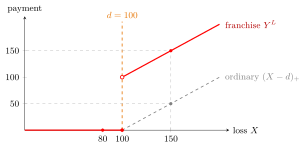
The figure draws the Examples case . Below the threshold both rules pay nothing, so the loss 80 gives payment 0. Above it the franchise payment (red) is the whole loss, while the ordinary-deductible payment (dashed) is lower: the loss 150 gives 150 against 50. The open circle at marks the jump: under the strict rule a loss of exactly 100 is not paid, and no payment lies strictly between 0 and 100.
Key Results
- when finite.
- Payment probability is the same as for an ordinary deductible, but qualifying payments are larger by .
- For , there are no payment amounts strictly between zero and .
- Whether equality qualifies is a contract convention; here the threshold rule is strict.
Examples
At deductible 100, losses 80 and 150 produce franchise payments 0 and 150. The ordinary deductible would produce 0 and 50.
Prerequisites
Related Concepts
Sources
- Risk Insurance · Lecture 2
Aliases: franchise insurance, threshold deductible, franchise Keywords: Y = X 1{X > d}, E[Y^L] = E[(X - d)+] + d P(X > d), jump at the threshold, franchise versus ordinary deductible
Last updated: 16 October 2026 22:28
Franchise DeductibleOrdinary DeductibleStop-Loss Transform and ReinsuranceMixed Discrete and Continuous Loss Distribution