Coinsurance
Definition
Under coinsurance, the insurer pays a specified proportion of a covered loss and the insured or another insurer pays the rest. Without other modifications, insurer payment is .
Interpretation
Both parties share each covered monetary unit. Combining coinsurance with an ordinary deductible or policy limit requires specifying the order of those operations.
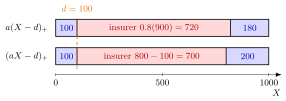
The figure splits the Example's loss , with and deductible , between the insured (blue) and the insurer (red). Applying the deductible first leaves an excess of 900, of which the insurer pays and the insured keeps . Sharing first gives the insurer before the deductible, so it pays and the insured keeps . The gap of 20 is : sharing after the deductible lowers the insurer's payment below by only , while deducting after sharing lowers it by the full .
Variance and standard deviation explains why proportional sharing scales the variance quadratically: multiplying each realized loss by multiplies its deviation from the mean by , and its squared deviation by .
Key Results
- and when finite.
- For , .
- means sharing an already capped excess. It differs from .
- In reinsurance, a quota-share treaty applies the same proportional split to the insurer's portfolio losses: the reinsurer pays a fixed share of every loss.
Examples
With , and deductible 100, sharing after the deductible gives . Applying the deductible after sharing gives .
Prerequisites
Related Concepts
Sources
- Risk Insurance · Lecture 3
Aliases: proportional insurance, quota-share payment, co-insurance, proportional coverage Keywords: Y = aX, insurer share a, order of deductible and coinsurance, Var(aX) = a^2 Var(X), quota-share treaty Symbols: element of
Last updated: 14 October 2026 08:21
CoinsuranceOrdinary DeductibleVariance and Standard DeviationPolicy LimitPremium Principles and Their Properties