Stop-Loss Separation Theorem
Theorem
For nonnegative integrable losses, if and , the separation theorem guarantees a loss law such that and .
Interpretation
The comparison can be separated into an increase in loss size followed by an equal-mean convex-order comparison. The intermediate variable describes a distribution; the theorem does not specify a unique insurance contract.
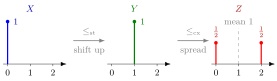
The figure draws the Examples case. The first arrow moves all the mass of up to , an increase in loss size (); the second spreads the mass of out to 0 and 2 around the common mean 1 (). Together the two steps decompose the original comparison , in which .
Stochastic order forms the first comparison, increasing loss size from to . Stop-loss order forms the second, comparing expected excesses of and at every retention; matching their means turns this second step into a dispersion comparison.
Key Results
- The equal-mean second step is .
- The theorem gives existence, not uniqueness of .
- Outside the theorem's hypothesis: if and already have equal means, then directly, so gives the same decomposition.
- Matching the means alone is insufficient; both order requirements must also hold.
Examples
Let and equal 0 or 2 with equal probabilities. Choosing gives , and matching means of 1 for .
Prerequisites
Related Concepts
Sources
- Risk Insurance · Lecture 11
Aliases: equal-mean intermediate risk, separation of size and dispersion, separation theorem Keywords: X ≤_st Y ≤_cx Z, stochastic order followed by convex order, intermediate risk
Last updated: 17 October 2026 21:53
Stop-Loss Separation TheoremStochastic OrderStop-Loss OrderConvex Order and More Dangerous RisksRisk Orders Under Aggregation