Loss Elimination Ratio
Definition
For and ordinary deductible , the loss elimination ratio (LER) is
Interpretation
The ratio measures the share of expected ground-up loss removed from insurer payments. It concerns expected amounts, rather than the fraction of claims receiving no payment.
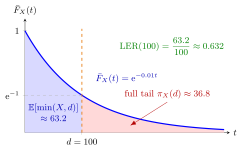
For the whole area under is . The blue part over is , the expected amount that the deductible removes from insurer payments, while the red tail is , the expected payment that remains. The loss elimination ratio is the blue share of the total area, , as in the example.
The stop-loss transform and reinsurance gives , the expected payment remaining above the deductible. Subtracting this from the ground-up mean and dividing by that mean produces the eliminated share.
Key Results
- and it increases with .
- .
- It is zero at and tends to one as .
- A zero or infinite ground-up mean makes this ratio inappropriate without further conventions.
Examples
For exponential losses at rate and deductible 100, LER is . The payment probability is , a different quantity.
Prerequisites
Related Concepts
Sources
- Risk Insurance · Lecture 2
Aliases: LER, deductible loss reduction ratio Keywords: LER(d) = E[min(X, d)]/E[X], expected loss eliminated by a deductible, 1 - E[(X - d)+]/E[X], exponential loss elimination ratio Symbols: infinity, integral, pi
Last updated: 22 October 2026 19:04
Loss Elimination RatioOrdinary DeductibleStop-Loss Transform and ReinsurancePolicy Limit