Rating Factors and Interactions in Insurance GLMs
Definition
A rating factor is a covariate used in an insurance generalized linear model (GLM) to distinguish expected insured risk. A categorical factor with levels can be represented by indicator variables relative to a reference level when an intercept is included. An interaction allows the effect of one factor to depend on another.
Interpretation
Under a log link, additive predictor terms become multiplicative rate effects. An interaction changes a rate ratio across groups rather than simply adding another independent multiplier.
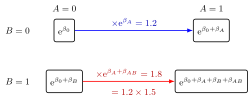
Each cell is the rate for one combination of the binary factors. Moving from to multiplies the rate by when , but by when , the values in the example. Without the interaction term the two arrows would carry the same multiplier.
Poisson regression supplies the log-link interpretation of predictor coefficients as multiplicative count effects. With exposure offset in claim-frequency models, is separated from those rating effects so that the coefficients compare claim rates at equal exposure.
Key Results
- In , with binary , the effect of is .
- Including all category indicators plus an intercept makes the design redundant: the indicators sum to the intercept column, so the coefficients are not identifiable unless a constraint is imposed, such as dropping a reference level.
- Reference categories determine coefficient interpretation but do not change fitted means under an equivalent encoding.
- A fitted association does not establish a causal effect of a rating factor.
Examples
If and , the rate ratio for is 1.2 when , and 1.8 when .
Prerequisites
Related Concepts
Sources
- Risk Insurance · Lecture 6
Aliases: categorical rating factors, multiplicative rating effects, rating factor, rating variable, tariff variable Keywords: dummy coding, reference level, interaction term, rate ratio, k - 1 indicator variables, identifiability Symbols: beta, lambda
Last updated: 17 October 2026 21:53
Rating Factors and Interactions in Insurance GLMsBonus-Malus SystemPoisson RegressionExposure Offset in Claim-Frequency ModelsIndicator Random VariableInformation Criteria for Risk Models