Compound Poisson Process
Definition
For a Poisson process of rate and i.i.d. severities independent of the entire process, the compound Poisson process is , . It records cumulative claims over time.
Interpretation
The path stays constant between claim arrivals and jumps by each arriving claim amount. A compound Poisson distribution describes one time horizon; this process describes all horizons consistently.
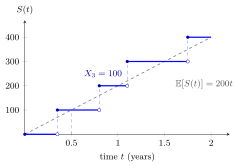
The figure shows one possible path for the Example's portfolio (claim rate 2 per year, every claim 100), with claims arriving at the illustrative times 0.35, 0.8, 1.1 and 1.75. The path is flat between arrivals and jumps by the claim amount at each one; a filled dot marks the value at the arrival time, which already includes that claim. The dashed line is the mean , which equals 100 at , as in the Example.
The Poisson process supplies both the number and timing of arrivals. Attaching one independent severity to each arrival produces the jumps; its independent increments, together with independent severities, give independent loss increments.
Key Results
- is compound Poisson with frequency parameter .
- It has stationary independent increments: has the same law as for all , and increments over disjoint intervals are independent.
- and when finite.
- The insurer's surplus (its capital) at time , starting from initial capital and collecting premiums at constant rate , is . Ruin, the event that the surplus becomes negative at some time, is not developed here.
Examples
With claim rate 2 per year and fixed severity 100, and . Mean half-year loss is 100.
Prerequisites
Related Concepts
Sources
- Risk Insurance · Lecture 4
Aliases: aggregate claims process, marked Poisson loss process, compound Poisson claims process, cumulative claims process, aggregate claim process Keywords: S(t) = X_1 + ... + X_N(t), stationary independent increments, surplus process, u + ct - S(t), Poisson claim arrivals Symbols: lambda, sum
Last updated: 17 October 2026 21:53
Compound Poisson ProcessCompound Poisson DistributionPoisson ProcessMaximum Claim in a Portfolio