Stop-Loss Order
Definition
For integrable nonnegative losses, stop-loss order means for every . The course states it for ; continuity as supplies the mean comparison at zero.
Interpretation
Every excess-loss layer has no larger expected payment for . This order combines size and dispersion, so it does not require equal means.
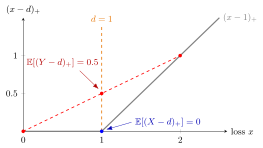
The figure takes the Examples case at retention . The payment is convex, so the expected payment of , which is 0 or 2 with equal probabilities, is the midpoint of the chord between and , namely 0.5; the constant sits at the kink and pays 0. The same chord argument works at every retention, which gives for all , that is, .
The stop-loss transform and reinsurance is the expected payment above each retention. Ordering those transforms yields the definition. Jensen's inequality explains the constant-loss example: is convex, so a constant at the mean has no larger expected excess than the original loss.
Key Results
- It is equivalent to increasing convex order: for increasing convex whenever the expectations are defined.
- It implies and is transitive.
- Stochastic order and the equal-mean thicker-tailed comparison each imply stop-loss order.
- Without equal means, stop-loss order need not imply a variance comparison.
- Increasing convex transformations preserve the order when the transformed quantities meet the needed integrability conditions.
Examples
Let and equal 0 or 2 with equal probabilities. At , expected excesses are 0 and 0.5; their stop-loss transforms are ordered at every retention.
Prerequisites
Related Concepts
- Convex Order and More Dangerous Risks
- Exponential Order
- Risk Orders Under Aggregation
- Thicker-Tailed Comparison
- Second-Order Stochastic Dominance
- Crossing Criteria for Risk Orders
- Stochastic Order
Sources
- Risk Insurance · Lecture 9
Aliases: increasing convex order, ordering of stop-loss premiums, stop-loss ordering Keywords: X ≤_sl Y, E[(X - d)+] ≤ E[(Y - d)+], increasing convex functions, every retention d
Last updated: 14 October 2026 08:21
Stop-Loss OrderConvex Order and More Dangerous RisksExponential OrderPremium Principles and Their PropertiesRisk Orders Under AggregationStop-Loss Separation TheoremStop-Loss Transform and ReinsuranceJensen InequalityThicker-Tailed ComparisonSecond-Order Stochastic DominanceCrossing Criteria for Risk OrdersStochastic Order