Policy Limit
Definition
A policy limit caps the insurer's payment. Without a deductible, payment is . With an ordinary deductible and maximum payment , it is . A maximum covered ground-up loss is a different convention and must be stated separately.
Interpretation
The cap creates a point mass at the maximum payment whenever losses can reach or exceed it. A deductible controls the bottom of the covered layer (the band of loss amounts from to that the insurer pays); a payment limit controls its width.
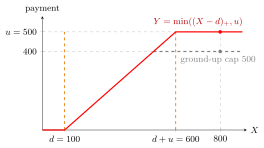
With and , the red payment is zero below the deductible, rises one-for-one through the covered layer from to , and stays at for every larger loss; all those losses form the point mass at the maximum payment. A loss of 800 is therefore paid 500. The dashed grey line shows the other convention from the example: capping the ground-up loss at 500 before applying the deductible pays .
The stop-loss transform and reinsurance values the unbounded layer above a retention , the amount the insurer keeps. When the transforms are finite, subtracting the transform at from the transform at removes payments beyond the cap. The finite-layer integral below remains valid even when the uncapped transforms are infinite.
Key Results
- for nonnegative .
- for finite . If , this also equals .
- For , the capped excess has mass at .
- For , its mass at zero is ; at the entire payment is zero.
Examples
If deductible is 100 and maximum insurer payment is 500, a ground-up loss of 800 gives payment 500. A ground-up coverage cap of 500 instead would give payment 400.
Prerequisites
Related Concepts
- Mixed Discrete and Continuous Loss Distribution
- Coinsurance
- Likelihood for Censored Loss Data
- Loss Elimination Ratio
Sources
- Risk Insurance · Lecture 2
Aliases: maximum insurer payment, coverage limit, payment limit Keywords: limited expected value, min((X - d)+, u), covered layer, point mass at the limit, E[min(X, u)] Symbols: infinity, integral, pi
Last updated: 14 October 2026 08:21
Policy LimitPoint MassOrdinary DeductibleStop-Loss Transform and ReinsuranceMixed Discrete and Continuous Loss DistributionCoinsuranceLikelihood for Censored Loss DataLoss Elimination Ratio