Crossing Criteria for Risk Orders
Proposition
For absolutely continuous laws, suppose is nonnegative before a threshold and nonpositive afterwards, with both densities integrating to one. Then for all , so . The crossing criterion is sufficient; it is not a necessary requirement for stochastic order.
Interpretation
Integrating the signed density difference accumulates a nonnegative cumulative distribution function (CDF) difference before the crossing and then brings it back to zero. The direction of the signs matters more than merely counting intersections.
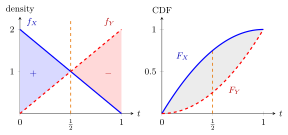
The figure draws the Examples case. On the left, is positive before the crossing at (blue region) and negative after it (red region). On the right, the CDF difference accumulates these signed areas: it grows until and then shrinks back to zero at without becoming negative, so everywhere and .
Key Results
- With equal finite means, the pattern , then , then on three consecutive intervals gives the direct thicker-tailed comparison.
- Multiple density crossings do not by themselves decide stochastic order.
- Density comparisons are almost-everywhere comparisons; changing a density at one point changes no probabilities.
- For discrete laws, use cumulative masses rather than derivatives.
Examples
On , and cross at . Their CDFs are and , confirming .
Prerequisites
Related Concepts
Sources
- Risk Insurance · Lecture 9
Aliases: single density crossing criterion, two-crossing dispersion criterion, density crossing criterion, single-crossing criterion Keywords: sign change of f_X - f_Y, sufficient condition for stochastic order, three-interval sign pattern, densities crossing once
Last updated: 16 October 2026 22:28
Crossing Criteria for Risk OrdersAbsolutely Continuous DistributionStochastic OrderThicker-Tailed ComparisonProbability Density FunctionStop-Loss Order