Poisson Regression
Definition
In Poisson regression, conditionally independent counts satisfy with . Thus and .
Interpretation
The model relates rating factors to expected claim counts through multiplicative effects. It does not directly model claim severity.
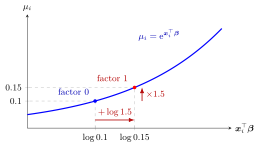
The log link turns additive changes in the linear predictor into multiplicative changes in the mean. In the example below, the reference group has and mean ; switching the binary rating factor on adds its coefficient , which multiplies the mean by to give . Because is always positive, no predictor value can produce a negative expected count.
This is a generalized linear model with a logarithmic link and response law from the Poisson distribution. The link enforces a positive mean, while the Poisson law supplies equality of the conditional mean and variance and the stated likelihood.
Key Results
- Increasing covariate by one multiplies the mean by if the model has no relevant interaction.
- The independent-data log-likelihood is .
- Equality of conditional mean and variance is the Poisson assumption; heterogeneity across covariates does not by itself violate it.
- Different observation durations require exposure adjustment.
Examples
With intercept and a binary rating coefficient , the two conditional means are 0.1 and 0.15 at the same exposure.
Prerequisites
Related Concepts
- Exposure Offset in Claim-Frequency Models
- Overdispersion in Count Models
- Rating Factors and Interactions in Insurance GLMs
Sources
- Risk Insurance · Lecture 6
Aliases: log-link count regression, claim-frequency regression, Poisson GLM, Poisson log-linear model Keywords: log link, μ_i = exp(x_i^T β), multiplicative effects, rate ratio e^(β_j), Poisson log-likelihood Symbols: beta, mu, sum
Last updated: 16 October 2026 22:28
Poisson RegressionExposure Offset in Claim-Frequency ModelsOverdispersion in Count ModelsRating Factors and Interactions in Insurance GLMsGeneralized Linear ModelPoisson Distribution