Compound Poisson Distribution
Definition
A compound Poisson loss is with , , and i.i.d. nonnegative severities independent of . The empty sum is zero.
Interpretation
Poisson frequency makes aggregate losses particularly tractable. Even with continuous positive severities, aggregate loss includes a probability of no claims at all.
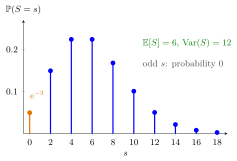
The figure plots the Example's loss with , so . The orange bar at zero is the no-claim probability , present even though every claim is positive. The mass sits only on even values, and the mean and variance follow from the Key Results; a Poisson variable with mean 6 would have variance 6.
Move and pick a claim-size law: and , and the spike at 0 always has height . With claims fixed at 2, lives on the even numbers.
This specializes the compound risk distribution by choosing the count from the Poisson distribution. Since its count mean and variance both equal , the general random-sum variance simplifies to .
Key Results
- and when finite.
- The moment generating function (MGF) satisfies where finite.
- With strictly positive severity, .
- Claim counts for disjoint severity categories are independent Poisson variables with rates (with the probability that a claim falls in category ); this uses the Poisson splitting result.
Examples
If each claim is 2 and , then has mean 6 and variance 12. Its support is , so it is not an ordinary Poisson variable.
Prerequisites
Related Concepts
- Superposition of Compound Poisson Risks
- Compound Poisson Process
- Poisson Splitting
- Collective Risk Model
- Cumulant Generating Function
- Maximum Claim in a Portfolio
- Risk Orders Under Aggregation
Sources
- Risk Insurance · Lecture 4
Aliases: compound Poisson aggregate loss, compound Poisson, compound Poisson random variable Keywords: Poisson frequency model, M_S(t) = exp(λ(M_X(t) - 1)), Var(S) = λ E[X^2], no-claim probability e^(-λ), Poisson splitting by claim category Symbols: lambda, sum
Last updated: 17 October 2026 21:53
Compound Poisson DistributionCompound Poisson ProcessSuperposition of Compound Poisson RisksCompound Risk DistributionPoisson DistributionPoisson SplittingCollective Risk ModelCumulant Generating FunctionMaximum Claim in a PortfolioRisk Orders Under Aggregation