Stochastic Order
Definition
For loss variables , stochastic order means for every real threshold . Equivalently, for every . Equal laws satisfy the weak order in both directions.
Interpretation
The larger ordered loss has at least as much probability above every threshold. For losses this is an adverse direction; for wealth or gains the same mathematical direction is favourable.
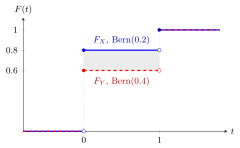
In the figure the cumulative distribution function (CDF) of is never below that of : the two coincide below 0 and from 1 onwards, and on the shaded gap is . Equivalently there, so has at least as much probability above every threshold, which is .
Move and : holds exactly when the CDF of is never below that of , here when . Swap the order of the two probabilities to see the verdict flip.
The cumulative distribution function gives probability at or below a threshold, while the survivor function gives its complementary upper tail. Their opposite inequality directions express the same comparison of loss sizes.
Key Results
- if and only if for all bounded increasing .
- For increasing wealth utility , whenever defined.
- Increasing transformations preserve stochastic order.
- With finite means, the order implies ; equal means then force equal distributions.
Examples
If and , . The result compares laws and does not require a specified joint distribution.
Prerequisites
Related Concepts
- Thicker-Tailed Comparison
- Stop-Loss Order
- Crossing Criteria for Risk Orders
- Second-Order Stochastic Dominance
Sources
- Risk Insurance · Lecture 8
Aliases: first-order stochastic dominance, usual stochastic order, FSD, first-order dominance, stochastically larger, first-degree stochastic dominance Keywords: X ≤_st Y, F_X(t) ≥ F_Y(t), survivor function comparison, increasing test functions
Last updated: 17 October 2026 21:53
Stochastic OrderRisk Orders Under AggregationCrossing Criteria for Risk OrdersStop-Loss Separation TheoremThicker-Tailed ComparisonCumulative Distribution FunctionSurvivor FunctionStop-Loss OrderSecond-Order Stochastic Dominance