Loimaranta Efficiency
Definition
For a positive differentiable stationary premium at claim rate , Loimaranta efficiency is .
Interpretation
The elasticity measures the percentage change in long-run premium produced by a one-percent change in claim rate. A value near one means a proportional response locally, but does not establish accurate individual pricing.
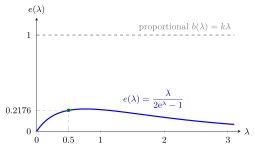
The figure plots the efficiency of the two-level one-year scheme from the Examples, . At it is about 0.2176: a one-percent rise in claim rate raises the long-run premium by only about 0.22 percent. The curve peaks at about 0.23 near and then falls, so at every claim rate this premium responds far less than the proportional premium with efficiency 1.
Move and switch schemes: is the slope of against , and it stays far below the efficiency 1 of a proportional premium. The default two-level scheme gives .
Derivative and differentiability gives the local premium response . Scaling it by converts an absolute slope into the relative response of premium to claim rate.
Key Results
- A proportional premium has efficiency one.
- A flat premium has efficiency zero.
- For the two-year discount scheme, .
- Numerical evaluation can use nearby log-rate and log-premium differences; check sensitivity to the step size.
Examples
For a two-level one-year scheme, . At , efficiency is .
Prerequisites
Related Concepts
Sources
- Risk Insurance · Lecture 14
Aliases: bonus-malus premium elasticity, BMS efficiency, Loimaranta elasticity, efficiency of a bonus-malus system Keywords: e(λ) = λ b'(λ)/b(λ), d log b / d log λ, elasticity of the stationary premium, proportional premium has efficiency one Symbols: lambda
Last updated: 17 October 2026 21:53
Loimaranta EfficiencyStationary Bonus-Malus Distribution and PremiumDerivative and DifferentiabilityOptimal Bonus-Malus RelativitiesHunger for Bonus