Information Criteria for Risk Models
Definition
For a fitted likelihood model with maximized log-likelihood , estimated parameters and sample size , Akaike's information criterion is , and Bayesian information criterion is . Smaller values are preferred when models use comparable likelihoods on the same observations.
Interpretation
The fit improvement from extra parameters must compensate for their penalty. Stepwise selection searches neighbouring models and need not find the best model among all possible subsets.
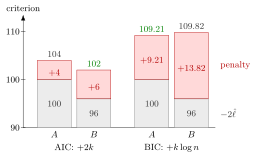
The figure draws the Examples case with ; the vertical axis starts at 90. Model B fits better, so its fit term is 4 lower, but it has one more parameter. AIC charges 2 for that parameter, so B wins with 102 against 104; BIC charges , more than the fit gain of 4, so A wins with 109.21 against 109.82 (B's BIC penalty is ).
Change the maximized log-likelihoods , the parameter counts and : AIC prefers model B here, while BIC, which charges per parameter, prefers model A once exceeds .
Maximum likelihood estimation supplies the maximized log-likelihood . When comparing fitted generalized linear model specifications with different rating predictors on the same observations, an extra coefficient can improve fit but also increases the parameter-count penalty.
Key Results
- Count all estimated likelihood parameters, including an estimated dispersion parameter where applicable.
- For , BIC penalizes each added parameter more than AIC.
- AIC and BIC are selection aids, not evidence of causal interpretation or predictive validation.
- Ordinary likelihood-based AIC is not directly available from a quasi-Poisson mean–variance specification alone.
Examples
With , model A has , , while B has , . AIC values are 104 and 102, favouring B; BIC values are about 109.21 and 109.82, favouring A.
Prerequisites
Related Concepts
Sources
- Risk Insurance · Lecture 6
Aliases: AIC, BIC, Schwarz criterion, Akaike information criterion, Bayesian information criterion, information criterion, Akaike's information criterion, Schwarz Bayesian criterion, Schwarz information criterion Keywords: stepwise model selection, AIC = -2ℓ̂ + 2k, BIC = -2ℓ̂ + k log n, model selection, parameter penalty
Last updated: 17 October 2026 21:53
Information Criteria for Risk ModelsMaximum Likelihood EstimationGeneralized Linear ModelRating Factors and Interactions in Insurance GLMsOverdispersion in Count Models