Stationary Bonus-Malus Distribution and Premium
Definition
A stationary distribution at claim rate , the general Markov-chain stationary distribution applied to the bonus-malus chain, is a row vector satisfying , and . With class premiums , the stationary mean premium is .
Interpretation
The bonus-malus transition matrix advances the class probabilities by one year. Setting the output equal to the input gives a linear system for the stationary proportions, with a normalization equation ensuring that they sum to one. The stationary distribution leaves class proportions unchanged after another year. Convergence from arbitrary initial proportions is a separate property, not a consequence of solving the stationary equation alone.
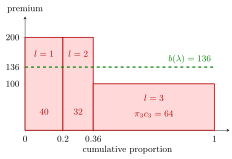
The figure uses the Examples numbers. Each class is a rectangle of width and height , so its area is that class's contribution to the mean premium: . The dashed level is the single premium that would collect the same total from the stationary portfolio; it lies between the bonus premium 100 and the premium 200, closer to 100 because most of the stationary mass sits in the third class.
Move and the class premiums: each rectangle has width and height , so the total area is . The default gives and .
Key Results
- A finite irreducible chain has a unique stationary distribution; aperiodicity additionally guarantees convergence from every initial distribution. These formal properties are covered in Year 3 Stochastic Models; solving the balance equations here does not require a convergence argument.
- is a left eigenvector of for eigenvalue one, normalized to sum to one.
- For the three-state two-year scheme, with and as in the transition-matrix example, .
- If the first two states cost and the third costs , .
Examples
With and , stationary proportions are . Premiums give mean premium .
Prerequisites
Related Concepts
Sources
- Risk Insurance · Lecture 13
Aliases: steady-state BMS premium, stationary rating-class distribution, stationary bonus-malus distribution, stationary BMS premium Keywords: πP = π, left eigenvector for eigenvalue one, b(λ) = Σ π_l c_l, balance equations, stationary mean premium Symbols: lambda, pi, sum
Last updated: 17 October 2026 21:53
Stationary Bonus-Malus Distribution and PremiumLoimaranta EfficiencyOptimal Bonus-Malus RelativitiesBonus-Malus Transition MatrixStandard Form of a Linear SystemEigenvalue and Eigenvector