Thicker-Tailed Comparison
Definition
For integrable losses of equal mean, is directly thicker-tailed than if some threshold satisfies for and for . This is the course's equal-mean comparison in which the two cumulative distribution functions (CDFs) cross once. At a jump, this convention assigns the crossing point to the upper interval. For continuous CDFs, the two inequalities force ; if a CDF jumps at , only is required there, not equality.
Interpretation
Probability shifts towards both lower and higher loss values while keeping the mean fixed. This is a relative dispersion comparison; it does not assert a particular asymptotic heavy-tail class.
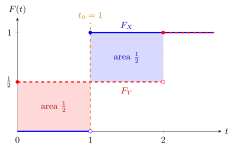
The figure draws the Examples case. Before the CDF of lies above that of (mass moved down to 0); from up to 2 it lies below (mass moved up to 2), and from 2 on the two agree. The two shaded gaps have the same area , which reflects the equal means: for nonnegative losses , so the signed gaps must cancel.
Change the two spreads: the CDFs cross once at , with above before the crossing and below it after. The two shaded gaps have equal area because the means are equal.
Stochastic order compares CDFs in the same direction at every threshold. Here the CDF direction reverses once, so the relation compares equal-mean dispersion rather than uniformly larger loss size; stochastic order is not the definition.
Key Results
- The direct single-crossing relation is not generally transitive. The notes use its transitive closure when they say indirectly thicker-tailed.
- The direct comparison implies stop-loss order .
- For with mean , the constant is the least dispersed and the two-point law on with upper mass is maximally dispersed in convex order.
- Unequal means do not meet the definition.
Examples
Let surely and let be 0 or 2 with equal probabilities. Both means are 1. The CDF of is above that of below 1 and below it between 1 and 2.
Prerequisites
Related Concepts
Sources
- Risk Insurance · Lecture 9
Aliases: single-crossing dispersion order, concentration and dispersion, thicker-tailed order, directly thicker-tailed Keywords: indirectly thicker-tailed, single crossing of CDFs, equal means, transitive closure, implies stop-loss order Symbols: infinity, integral, mu
Last updated: 17 October 2026 21:53
Thicker-Tailed ComparisonCrossing Criteria for Risk OrdersStochastic OrderStop-Loss OrderConvex Order and More Dangerous Risks