Bonus-Malus Transition Matrix
Definition
At a fixed claim rate , let . The transition matrix has nonnegative entries and each row sums to one. For row-vector level probabilities , the next-year distribution is .
Interpretation
The bonus-malus system supplies the rule assigning next year's class from the current state and claim count. The entries above are conditional probabilities given the current state; the matrix product adds their contributions to the next-year class probabilities.
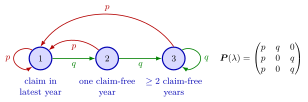
Each arrow in the figure is one entry of from the Example, with and . Red arrows are years with a claim: from every state they lead to state 1, which fills the first column with . Green arrows are claim-free years: state 1 moves to 2, while states 2 and 3 move to 3. The arrows leaving state give row , and their probabilities sum to .
Pick a starting state and move the year and the claim rate : reaches the stationary law after two years from any start. The default gives .
The state must store enough history for the transition rule. For a two-year claim-free discount, a simple high/low premium label may omit the information needed for next year.
Key Results
- Under a deterministic rule and Poisson count, .
- At a fixed rate with independent yearly claims, .
- The notes' three states are a claim in the latest year, one claim-free year after a claim, and at least two claim-free years.
- Matrix orientation must match the row-vector convention. The general Markov chain framework is formalized in Year 3 Stochastic Models; the transition calculation here uses the conditional probabilities defined above.
Examples
With and , the three-state matrix has rows , and . These rows each sum to one.
Prerequisites
Related Concepts
Sources
- Risk Insurance · Lecture 13
Aliases: rating-class transition probabilities, BMS Markov chain, BMS transition matrix, bonus-malus Markov chain Keywords: p_ij(λ), row-stochastic matrix, a_{t+1} = a_t P, three-state scheme, transition rule T(i, n) Symbols: lambda, sum
Last updated: 14 October 2026 08:21
Bonus-Malus Transition MatrixStationary Bonus-Malus Distribution and PremiumBonus-Malus SystemConditional ProbabilityMatrix Product