Absolute Risk Aversion
Definition
For twice differentiable increasing utility with , the absolute risk aversion coefficient is . It measures local curvature relative to marginal utility at wealth .
Interpretation
Curvature determines how much a small uncertain loss matters beyond its mean. The coefficient is unchanged by positive affine transformations of utility.
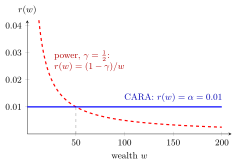
The figure plots for two utilities from the Key Results. Exponential utility with , the coefficient of the Example, has the same curvature at every wealth level, so the certainty equivalent of a given small risk lies below by about the same amount, , however wealthy the policyholder is. Power utility with (chosen for the figure) has : it is more risk averse than the exponential utility below and less above, and its aversion to a fixed small risk fades as wealth grows.
Move the wealth : the exponential stays flat while the power utility's falls with wealth. The approximate premium for a small risk of variance 100 is 0.5 at .
Expected utility and risk aversion relates concave utility to aversion to uncertain wealth. The higher-order derivative measures that curvature; dividing its negative by marginal utility makes the local coefficient unchanged by positive affine changes of utility.
Key Results
- Exponential utility has constant absolute risk aversion (CARA) .
- Power utility , , , has .
- For a small mean-zero risk , the certainty equivalent (the sure wealth with the same expected utility as ) lies below by approximately , with smoothness and moment conditions for the Taylor approximation.
- This local approximation is not an exact formula for arbitrary large losses.
Examples
With exponential coefficient and a sufficiently small centred loss of variance 100, the second-order premium above the mean is approximately .
Prerequisites
Related Concepts
Sources
- Risk Insurance · Lecture 7
Aliases: Arrow–Pratt coefficient, Arrow–Pratt measure of absolute risk aversion, coefficient of absolute risk aversion, absolute risk aversion coefficient, ARA, Pratt–Arrow measure, Arrow–Pratt measure Keywords: CARA utility, constant absolute risk aversion, r(w) = -u''(w)/u'(w), small-risk premium, exponential utility, power utility Symbols: alpha, epsilon, gamma
Last updated: 17 October 2026 21:53
Absolute Risk AversionInsurance Indifference PremiumsExpected Utility and Risk AversionHigher-Order DerivativeExponential Premium Principle