Stop-Loss Transform and Reinsurance
Definition
For a nonnegative integrable loss , its stop-loss transform at retention is . In reinsurance, an insurer passes (cedes) part of its losses to a reinsurer under a contract called a treaty and keeps the rest, its retention. A stop-loss treaty pays the excess of an aggregate loss over its retention; the same positive-part function can describe excess-of-loss cover on an individual claim.
Interpretation
The transform is the expected covered tail beyond a deductible. It distinguishes risks that have the same mean but different upper-tail exposure.
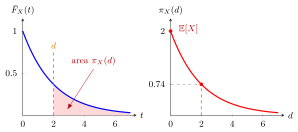
The figure applies the Examples formula with , so and . The shaded area under the survivor function beyond equals , the height of the marked point on the right. As the retention grows, the transform falls convexly from towards zero, and its slope at is .
Move the retention : the red area under to the right of is , drawn as the point on the right-hand curve, and the tangent there has slope . Change to rescale the curve, which starts at .
An ordinary deductible produces the payment . Its expectation is therefore the stop-loss transform: the function records the expected ceded payment as the retention changes.
Key Results
- .
- It is nonincreasing and convex in , with and .
- Its right derivative is ; its left derivative is .
- The retained loss plus the ceded excess equals .
Examples
For exponential loss of rate , . This follows by integrating its survivor function from onwards.
Prerequisites
Related Concepts
Sources
- Risk Insurance · Lecture 2
Aliases: stop-loss premium, excess-of-loss payment, stop-loss transform, stop-loss reinsurance, stop-loss treaty Keywords: π_X(d) = E[(X - d)+], retention, ceded loss, reinsurance treaty, integral of the survivor function Symbols: infinity, integral, lambda, pi
Last updated: 17 October 2026 21:53
Stop-Loss Transform and ReinsuranceLoss Elimination RatioPolicy LimitStop-Loss OrderOrdinary DeductibleExpectationFranchise DeductiblePareto Loss Model