Premium Principles and Their Properties
Definition
A premium principle is a rule assigning a price to a loss law . The course considers nonnegative loading , no rip-off (the essential supremum, the smallest with , i.e. the largest possible loss), translation consistency , additivity for independent losses, proportionality and iterativity .
Interpretation
The properties describe how pricing reacts to certain cash flows, rescaling, pooling and conditioning. A plausible-looking formula need not satisfy all of them.
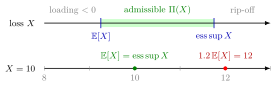
Nonnegative loading and no rip-off together confine a premium to the green band . For the deterministic loss in the example, both ends equal 10, so the band shrinks to a single point. The expected-value premium satisfies the loading condition but lies above the largest possible loss, so it violates no rip-off.
Pick a principle and a loss, then move or : each readout checks one property on this loss, and a single cross is a counterexample. The default on charges 12 and violates no rip-off.
Stop-loss order is one way to check whether a pricing rule respects a risk comparison. For example, it orders finite means, so an expected-value premium with fixed nonnegative loading preserves the order. This does not imply that every premium principle has that property.
Key Results
- Iterativity applies the same rule first conditionally and then to the random conditional premium.
- A universal property needs a proof; one counterexample disproves it.
- An expected-value loading with positive coefficient fails translation consistency for positive constants.
- Risk-order compatibility can be checked by expressing a premium in terms of increasing or convex functions.
- No rip-off is only a finite upper bound when the loss is essentially bounded, that is, .
Examples
For and deterministic , the premium is 12. It violates no rip-off, since the largest possible loss is only 10.
Prerequisites
Related Concepts
- Expected Value Premium Principle
- Variance Premium Principle
- Standard Deviation Premium Principle
- Exponential Premium Principle
- Zero-Utility Premium
- Coinsurance
Sources
- Risk Insurance · Lecture 11
Aliases: premium functional, premium principle, premium calculation principle, properties of premium principles Keywords: nonnegative loading, no rip-off, translation consistency, additivity, proportionality, iterativity, premium loading Symbols: alpha, infinity, pi, theta
Last updated: 17 October 2026 21:53
Premium Principles and Their PropertiesExpected Value Premium PrincipleStandard Deviation Premium PrincipleVariance Premium PrincipleZero-Utility PremiumExpectationStop-Loss OrderExponential Premium PrincipleCoinsurance