Risk Orders Under Aggregation
Theorem
For independent nonnegative summands, stochastic and stop-loss orders are preserved when adding correspondingly ordered risks. For random sums, suppose i.i.d. nonnegative severities and are independent of their respective counts . If severities and counts are ordered in the same stochastic or stop-loss order, the corresponding aggregate losses inherit that order, subject to required integrability.
Interpretation
One can compare portfolios through frequency and severity without computing their full aggregate laws. Independence from the count and nonnegative severity are essential to the basic compounding statements.
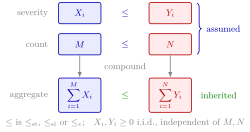
In the figure, the left column builds the aggregate loss from the severities and the count , and the right column builds from and . The two assumed comparisons, severity against severity and count against count, are in the same order (, or ); compounding under the independence and nonnegativity assumptions then passes that order on to the aggregate losses, with finite aggregate means needed in the stop-loss case.
This illustrates the Bernoulli-policy result with claim size : change and the retention . The compound sum with has the same mean as but a stop-loss premium at least as large at every , because it allows two or more claims.
Stochastic order compares all increasing tests, including indicators of threshold exceedance. The compound risk distribution supplies the random-sum structure: comparing both count and severity laws under its independence assumptions leads to the aggregate comparisons below.
Key Results
- If and , then under the stated model.
- The analogous result holds for stop-loss order with finite aggregate means.
- Exponential order also passes to these random sums when the nonnegative severities and counts are exponentially ordered and the required moment generating functions (MGFs) are finite: for and , . Nonnegative severities ensure the log-MGF arguments are nonnegative.
- For i.i.d. nonnegative independent of , when .
- A Bernoulli-policy loss is below the compound sum in stop-loss order if and the independence assumptions hold.
Examples
An individual policy with claim probability and severity is stop-loss dominated by a compound Poisson model with rate and the same severity. Their means agree, but the Poisson model allows multiple claims.
Prerequisites
Related Concepts
Sources
- Risk Insurance · Lecture 11
Aliases: convolution preserves risk order, compounding preserves risk order, preservation of risk orders Keywords: random sums, stochastic order of aggregate losses, stop-loss order of compound sums, exponential order of random sums, individual versus compound Poisson model Symbols: alpha, sum
Last updated: 16 October 2026 22:28
Risk Orders Under AggregationStochastic OrderStop-Loss OrderCompound Risk DistributionExponential OrderIndividual Risk ModelCompound Poisson DistributionStop-Loss Separation Theorem