Generalized Linear Model
Definition
A generalized linear model (GLM) specifies a conditional response law from an exponential family, a mean , and a link such that . Here is the covariate vector, the coefficient vector and the linear predictor. The variance has form , where is the variance function of the chosen family and is a dispersion parameter ( for Poisson and Bernoulli responses).
Interpretation
The predictor is linear in coefficients, while the mean can be nonlinear and the conditional variance can depend on it. This allows count or binary responses without imposing an unconstrained linear mean. The family supplies the conditional response likelihood; maximum likelihood estimation fits the coefficients by maximizing its product over independent observations. The conditional expectation defines the mean being predicted, rather than predicting each observed response exactly.
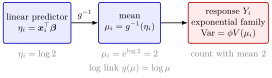
The diagram separates the three choices in the definition: the linear predictor, the link and the response family. Linearity holds only in the first box; the inverse link turns into the mean, and the family turns the mean into a distribution whose variance may depend on it. The grey row follows the Examples case under a log link: gives , an expected count rather than a guaranteed two claims.
Key Results
- The inverse link gives .
- Poisson regression uses and variance .
- A Gaussian identity-link model has conditional mean and constant variance.
- A quasi-likelihood model, such as the quasi-Poisson model with variance , specifies a mean–variance relation without necessarily specifying a complete response distribution.
Examples
If under a log link, the fitted conditional mean is 2. It is an expected count, not a guarantee of exactly two claims.
Prerequisites
Related Concepts
Sources
- Risk Insurance · Lecture 5
Aliases: GLM, generalised linear model Keywords: link function, linear predictor, η_i = x_i^T β, inverse link, variance function, dispersion parameter, log link Symbols: beta, eta, mu, phi
Last updated: 16 October 2026 22:28
Generalized Linear ModelInformation Criteria for Risk ModelsPoisson RegressionExponential FamilyMaximum Likelihood EstimationConditional Expectation Given a Random VariableOverdispersion in Count Models